VISAXUM
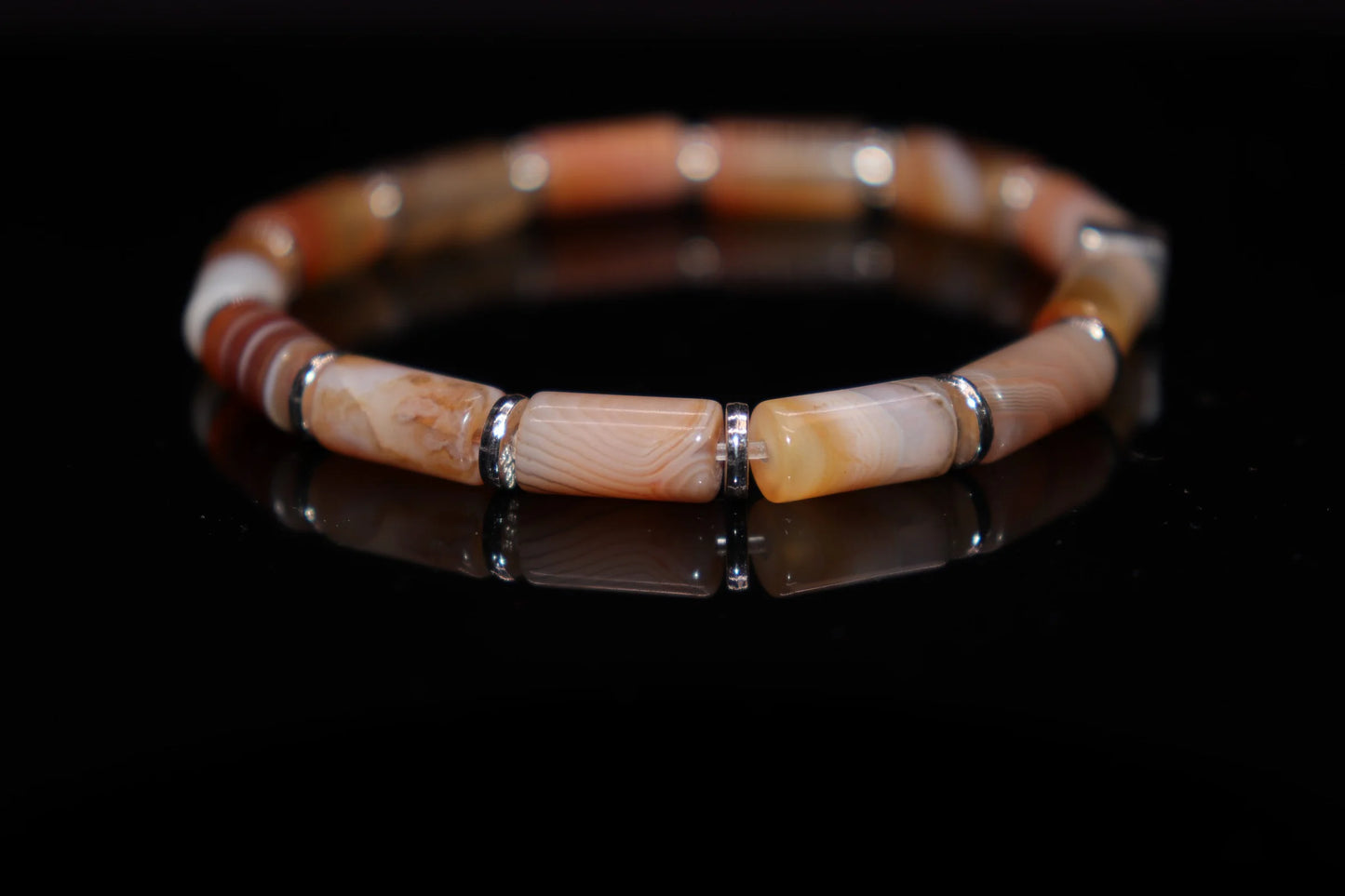
Agate Silver Bracelet (6mm)
Agate Silver Bracelet (6mm)
Couldn't load pickup availability
★ Custom - made according to your exact wrist size
★ Free shipping and returns
★ 30 - day satisfaction guarantee
★ Free resizing for new customers
Agate beads (6 mm), paired with 925 Sterling Silver beads. Comes with a cotton pouch.
Natural agate is semi-translucent, its soft, muted base colour crossed by fine concentric bands that ripple and shift as the stone turns under a gentle waxy lustre. The bands were laid down layer by layer by silica-rich water inside the gas bubbles of cooling lava – the densest stones hold thousands of bands in a single inch, and some even seal droplets of liquid water within. Its glow is quiet and deep, like a still pool that has kept a diary of time – calm, unhurried, quietly dignified.
Stone Stories
- Named for the Achates river of Sicily – recorded by Theophrastus around 315 BC, among Europe's earliest gem descriptions
- One of the "seven treasures" of the Buddhist sutras, adorning the ritual vessels of Japan's Shōsōin treasury
- A companion of Chinese culture for 8,000 years – from the agate scrapers of Neolithic Fuxin to the Qianlong Emperor's court beads
- State gem of Montana since 1969, and a recognised 12th and 14th wedding anniversary stone in several lists
A Letter from Fire and Water
Long ago, inside the gas bubbles of cooling lava, water rich in silica began to paint – layer after patient layer – and the stone it left behind reads like a diary written in rock. The Greeks wrote it down, the Romans named it for a Sicilian river, and Pliny marvelled at a stone on which nature herself had drawn Apollo and the nine Muses. The East gave it a place among the seven treasures of the Buddhist world; for eight thousand years it has run through Chinese hands, from the scrapers of a Neolithic village to the court beads chosen from three hundred kilograms of raw stone by the Qianlong Emperor. Banded, veined, impossibly patient – agate is time that chose to keep a diary. Wear it, and let the quietest chronicle on Earth keep writing itself on your wrist.
Cultural Allusions
- The agate of King Pyrrhus of Epirus showed Apollo with his lyre and the nine Muses "formed not by art, but by the will of nature" – Pliny cited it to prove that nature is the greatest artist of all. The Romans cut intaglios from agate for their signet rings; the British Museum keeps a Roman gold ring engraved with the drinking-goddess Methe raising a cup, and medieval Europe often reused Roman agate gems.
- The Persians, Pliny records, believed that burning agate drove away storms and stopped rivers in their course, and that plain-coloured agate made athletes invincible. The eleventh-century scholar al-Bīrūnī grouped quartz, chalcedony and onyx by their physical nature and measured their density with a cone of his own making – the beginning of gemmology as a science; Yemeni agate (aqeeq) has been prized in the Middle East since before Aristotle.
- In China, agate is an ancient member of the jade family: the Neolithic site of Chahai has yielded agate scrapers from 8,000 years ago; plain-faceted agate rings of the Warring States are treasured in the National Museum of China; Li Shizhen's Bencao Gangmu gives agate an entry of its own – "its veins cross like the brain of a horse, hence the name" – and prescribes it ground into powder for eye ailments. The Qianlong Emperor chose 108 beads, each holding a drop of natural water, from a 300-kilogram block, to make a Buddhist rosary of "agate with water within".
- In Islamic tradition the Prophet Muhammad wore a silver signet ring set with an Ethiopian stone – held to be agate or onyx, possibly Yemeni agate – inscribed "Muhammad is the Messenger of God", used to seal letters to the rulers of nations; it passed to the first three caliphs and was lost in the Well of Aris at Medina. "Whoever wears an agate ring, sorrow stays away," runs the old saying, and clergy of both sects wear it to this day.
- An amulet since Babylon and Egypt: agate was worn against poison, snakebite and evil influences, and Roman soldiers carried it for courage; the medieval bestiaries said the eagle placed agate in its nest to protect its young from serpents, and men wore the stone to keep snake venom at bay.
Did You Know?
- Agate is banded chalcedony – microcrystalline quartz; in the densest stones more than ten thousand bands can be counted within a single inch.
- Most agate is born in the gas bubbles of cooling lava: silica-rich groundwater later fills the cavity and deposits layer after layer of quartz on its walls.
- "Enhydro agate" holds liquid water sealed inside the stone – a famous specialty of Fuxin, China.
- Most brightly coloured agate on the market is dyed: Brazilian rough is naturally grey-white, and dyed stones show unnaturally even colour with pigment gathered along cracks – a 2024 NGTC sampling found about 27% of "Brazilian agate" bracelets were dyed.
- Agate is not an official modern birthstone – but bloodstone, its cousin in the chalcedony family, is a traditional March birthstone, and some folk lists once placed agate in May or September.
Care
- Clean with warm water, mild soap and a soft cloth or brush; rinse and dry thoroughly – never use an ultrasonic cleaner.
- Avoid high heat and long, direct sunlight – dyed or heat-treated agate can fade.
- Keep it away from perfume, hairspray, chlorine, salt water and strong acids; remove it for sport, swimming, gardening and housework.
- Wrap and store it separately, away from harder gems; the 925 sterling silver bead may darken with time – polish it gently with a silver cloth.
Wear your story.