VISAXUM
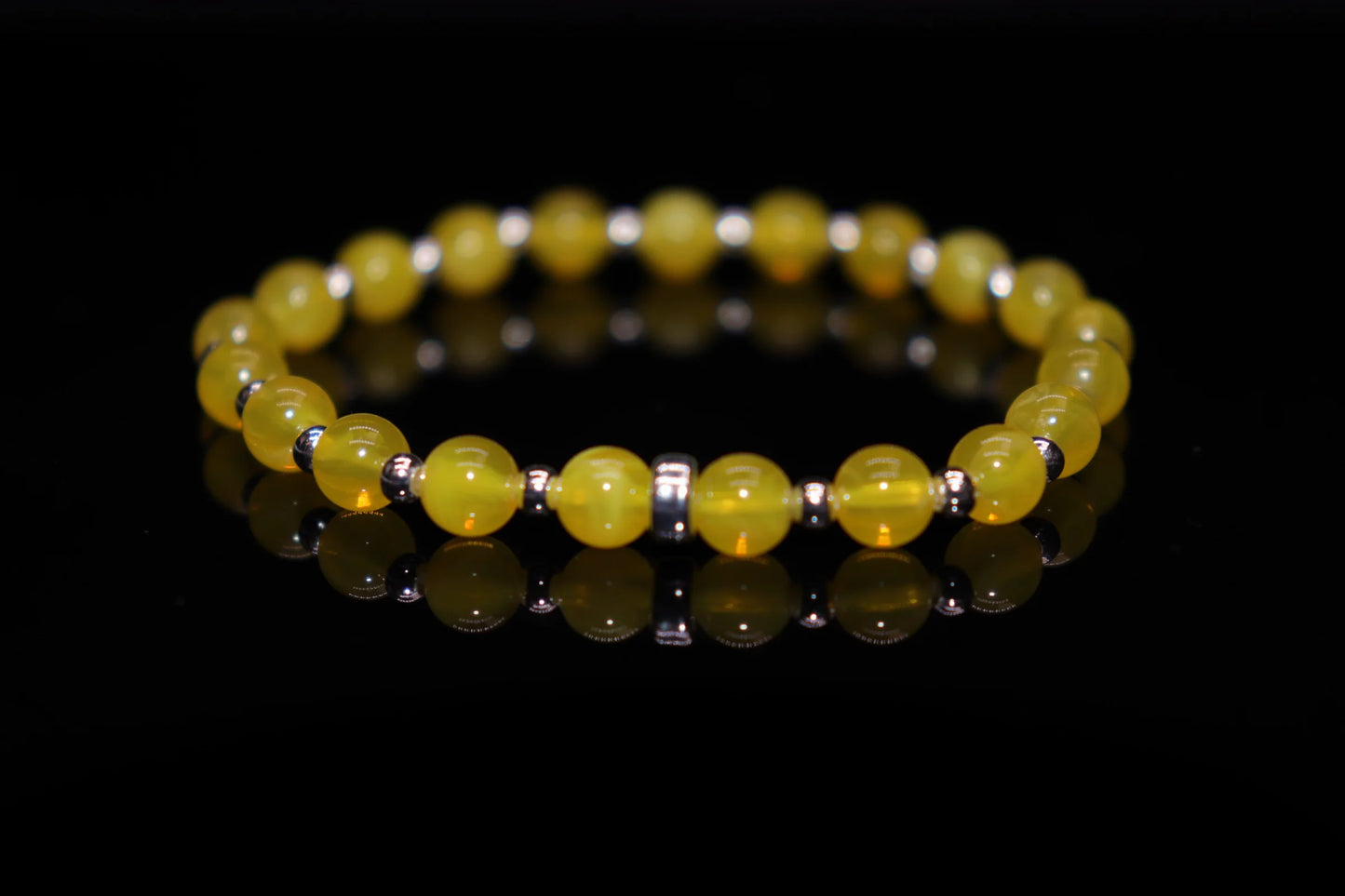
Amber Silver Bracelet (6mm)
Amber Silver Bracelet (6mm)
Couldn't load pickup availability
★ Custom - made according to your exact wrist size
★ Free shipping and returns
★ 30 - day satisfaction guarantee
★ Free resizing for new customers
Amber beads (6 mm), paired with 925 Sterling Silver beads. Comes with a cotton pouch.
Amber beads glow in warm honey-gold with a soft resinous sheen, the light seeming to melt slowly through each bead as it turns. Within the golden translucence lie natural flow lines and, in some beads, tiny inclusions sealed for tens of millions of years – the footprints of ancient resin. The glow is warm and weightless, like sunlight that has never gone cold – gentle, ancient, and quietly radiant.
Stone Stories
- Called "liquid sunlight" and "a pocket sun": a forty-million-year-old piece of summer
- The Romans knew it as the "gold of the North" and gave it to brides – a token of good fortune
- One of the seven treasures of Buddhism; long regarded as a stone of good fortune and a guardian of children
- Linked with the solar plexus – the centre of confidence and inner strength
Sunlight, Wept into Stone
Forty million years ago, a drop of resin slipped from a wounded tree and caught the light – and somewhere inside that golden teardrop, a summer's day was saved. The ancients knew the wonder at a glance. The Greeks said amber was the tears of the sun's daughters, wept by a river and hardened by sunlight; the Norse said the goddess Freyja cried gold onto the land and amber into the sea; the Balts told of a sea queen whose drowned palace still washes its gold upon the shore. The Romans called it the "gold of the North" and gave it to brides; the Teutonic Knights guarded its trade like treasure; and the tsars built a whole room of it – six tonnes of sunlight turned into walls. To wear amber is to wear a small piece of that long story: warm, weightless, older than kingdoms, softer than a sigh – still holding, after forty million years, the warmth of the day it fell.
Cultural Allusions
- In Greek myth, amber is the tears of the Heliades, daughters of the sun, who grieved for their brother Phaethon beside the river Eridanos until they became poplar trees; Ovid tells how their tears hardened into amber "for Roman brides to wear". The Greek word for amber, elektron, gave us "electricity" – for amber, when rubbed, attracts light objects.
- In Norse myth, the goddess Freyja wept for her absent husband: her tears fell to earth as gold and into the sea as amber. In Lithuanian legend, the sea queen Jūratė loved a mortal fisherman; when the thunder god shattered her amber palace, its fragments have drifted ashore ever since.
- Along the ancient Amber Road – the "gold of the North" – Baltic amber travelled to the Mediterranean for over two thousand years. Pliny records that the emperor Nero sent an expedition some 900 kilometres to the Baltic coast, returning with such quantities that even the gladiators' nets were set with amber.
- In the late Middle Ages the Teutonic Order held a strict monopoly on amber; its workshops turned it chiefly into rosary beads, and the craftsmen were called "paternoster-makers". Later, the fabled Amber Room – six tonnes of amber panels – was given to Peter the Great, vanished in the chaos of World War II, and was rebuilt and reopened in 2003.
- Amber is one of the seven treasures of Buddhism, listed in the Prajñāpāramitā and Amitāyus sutras; in China it was anciently called hupo, from the old belief that it was the soul of a tiger turned to stone.
Did You Know?
- The English words "electricity" and "electron" descend from the Greek name for amber, elektron – the first electrical experiment was simply rubbing a piece of amber.
- Amber is fossilised tree resin, not a mineral: press a warm needle to it (in a hidden spot) and you will smell pine and resin, not plastic.
- It is so light it floats in saturated salt water – the jeweller's classic "salt water test".
- The insect sealed inside a piece of amber is a species extinct for millions of years – which is why Jurassic Park's "dinosaur DNA from a mosquito" is pure fiction: DNA does not survive that long.
- The world's largest single piece of amber weighs 47 kilograms, found in Sumatra; the largest in Russia – 4.28 kg, named "Sunstone" – sits in the Kaliningrad Amber Museum.
Care
- Amber is soft (Mohs 2–2.5) – store it separately in a soft pouch, away from metal and other gems.
- Avoid heat: prolonged sun, saunas and radiators can darken or crack it.
- Alcohol and solvents dull or dissolve it – perfume, hairspray and hand sanitiser: last on, first off.
- Clean only with barely warm soapy water and a soft cloth, drying at once; never ultrasonic, steam or hot water.
Wear your story.