VISAXUM
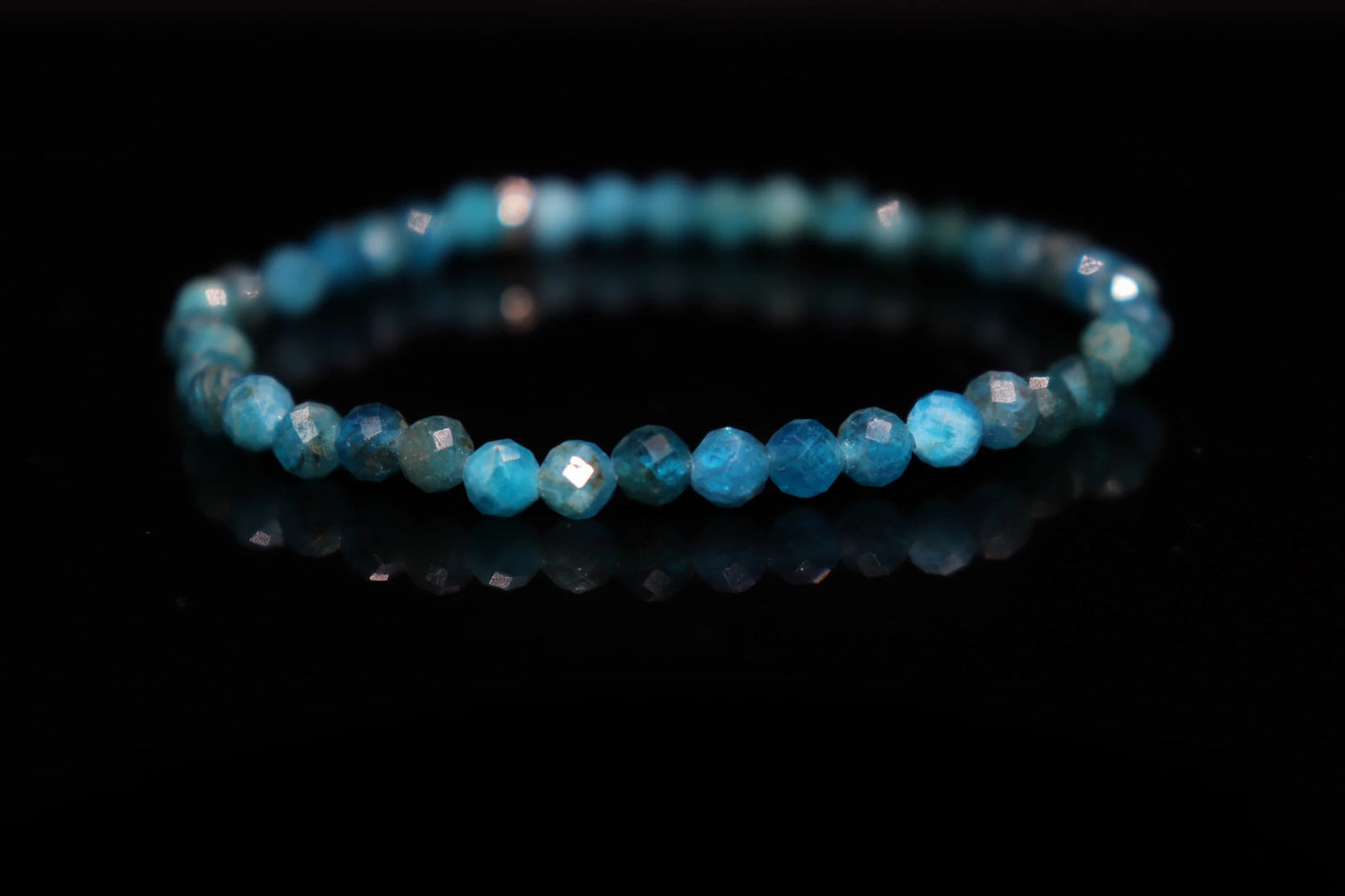
Blue Apatite Silver Bracelet (6mm)
Blue Apatite Silver Bracelet (6mm)
Couldn't load pickup availability
★ Custom - made according to your exact wrist size
★ Free shipping and returns
★ 30 - day satisfaction guarantee
★ Free resizing for new customers
Blue apatite beads (6 mm), paired with one 925 Sterling Silver logo bead. Comes with a cotton pouch.
- Named for deceit: apatite comes from the Greek apatē ("deception") – named in 1786 because it kept being mistaken for beryl, tourmaline and topaz
- The mineral of your own body: apatite forms your bones and tooth enamel, and fluoride toothpaste works by turning enamel into tougher fluorapatite
- "A rival to Paraíba blue": neon blue-green apatite from Madagascar, praised by gemologists as a blue to rival Paraíba tourmaline
- The hardest-working mineral on earth: about 95% of the phosphate rock mined every year goes to feed the world's crops
The Beautiful Deceiver
For most of history, apatite fooled everyone. It was mistaken for beryl, tourmaline, peridot, topaz, aquamarine – and the German mineralogist who finally named it in 1786 called it apatite, from the Greek apatē, "deceit," because the stone was so good at being something else. Yet the great deceiver kept a secret the ancients never guessed: it was never really a stranger. Apatite is the mineral of your own bones and tooth enamel, of the toothpaste that guards them, of the phosphorus that feeds the world's fields. When the blue kind at last came out of disguise – neon blue-green from Madagascar, praised as a rival to Paraíba tourmaline's celebrated blue – it was a newcomer with an ancient family: in a sense, you had been wearing it all along. Wear it now, and wear the most honest lie in the mineral kingdom.
Energy Properties
- Called the "stone of manifestation": believed to fire motivation and focus, bridging the gap between intention and action
- Believed to ease the fear of speaking – a stone of communication and self-expression, linked to the throat chakra
- Believed to aid intuition, concentration and insight, linked to the third-eye chakra; modern crystal culture also connects it to lucid dreaming and inner exploration
- Believed to lift dejection and emotional exhaustion and to balance appetite – fittingly, it is the very mineral of bones and teeth, and so is affectionately called the gem of the body.
Cultural Allusions
- The name came in 1786: the German geologist Abraham Gottlob Werner named the mineral apatite from the Greek apatē, "deception," because its colours and crystal habits made it endlessly confusable with beryl, tourmaline, peridot, amethyst, topaz and aquamarine – a "chameleon of the mineral kingdom." In Greek myth apatē is also the name of the goddess of deceit (Apate, daughter of Eris), but the mineral's name honours the concept, not the goddess; the English word entered general use around 1803.
- The blue variety had an older, forgotten name: moroxite, which entered mineralogical literature in 1798 as the German "Moroxit," from the Greek móroxos – a clay used in bleaching linen – itself traceable to the green stone morochthos mentioned by Pliny the Elder; its classic localities were Arendal in Norway and Pargas in Finland.
- Precious apatite spent all of antiquity in disguise: the records of Egypt, Greece, Rome and China contain no stone by this name, because the mineral was not named until 1786 and had always been taken for something grander.
- The stone that builds you: hydroxylapatite is the main mineral of tooth enamel (over 90% by weight) and of the inorganic phase of bone (60–70%). In the mid-20th century it was noticed that people in naturally fluoridated regions had fewer cavities; water fluoridation and fluoride toothpaste work by converting enamel's hydroxylapatite into tougher, acid-resistant fluorapatite – and the US CDC counts fluoridation among the ten great public-health achievements of the 20th century. About 95% of the phosphate rock mined each year goes to fertilizers that sustain modern agriculture.
- The neon blue-green apatite of Madagascar (around Fort Dauphin) entered the jewelry market only in the late 20th century, praised by gemologists as a "swimming pool-blue" to rival Paraíba tourmaline – a rare blue with an ancient family. Most of Madagascar's material is naturally dark green or grey-green, and is turned a bright blue-green by controlled heating at 650–700 °C – a standard enhancement, disclosed transparently. The Smithsonian holds a 4.25-carat Brazilian blue apatite as a sign of its new place in major gem collections.
Did You Know?
- Apatite is the index mineral for hardness 5 on the Mohs scale: a steel knife scratches it, but it cannot scratch glass.
- The "Apatite Piñata": a 99.21-carat dark green crystal from the Yates mine in Québec contains a round calcite inclusion – GIA nicknamed it a piñata, for the surprise inside.
- Brazil's "Brazil Blue" apatite from Minas Gerais is judged by some experts the most vivid and highest-priced of all blue apatites.
- Apatite spans nearly the whole spectrum – colourless, white, yellow, green, purple, red, brown, pink and blue – and the cause of the blue is still debated among scientists: manganese (Mn³⁺ or MnO₄³⁻) or an SO₃⁻ colour centre.
- In Chinese crystal circles it is affectionately called lan linhui (蓝磷灰), often paired with amazonite and aquamarine in "throat-chakra" bracelet sets – a modern hobbyist culture, not an ancient one.
Care
- It is fragile: hardness 5 and brittle – keep it in a soft pouch or separate compartment, away from harder gems such as diamond, sapphire and quartz.
- Avoid acid: sulfuric and hydrochloric acids attack it – keep it away from acidic substances, perfume, hairspray, cosmetics and chemical cleaners, including silver dips.
- Clean only by hand with warm water, mild soap and a soft brush or cloth; rinse well and dry. Ultrasonic, steam cleaning, boiling and hot water are all forbidden.
- It is sensitive to heat (heating changes its colour) and some blue stones may fade in sunlight – avoid heat and long direct sun; polish the silver bead with a silver cloth, keeping it clear of the apatite beads.