VISAXUM
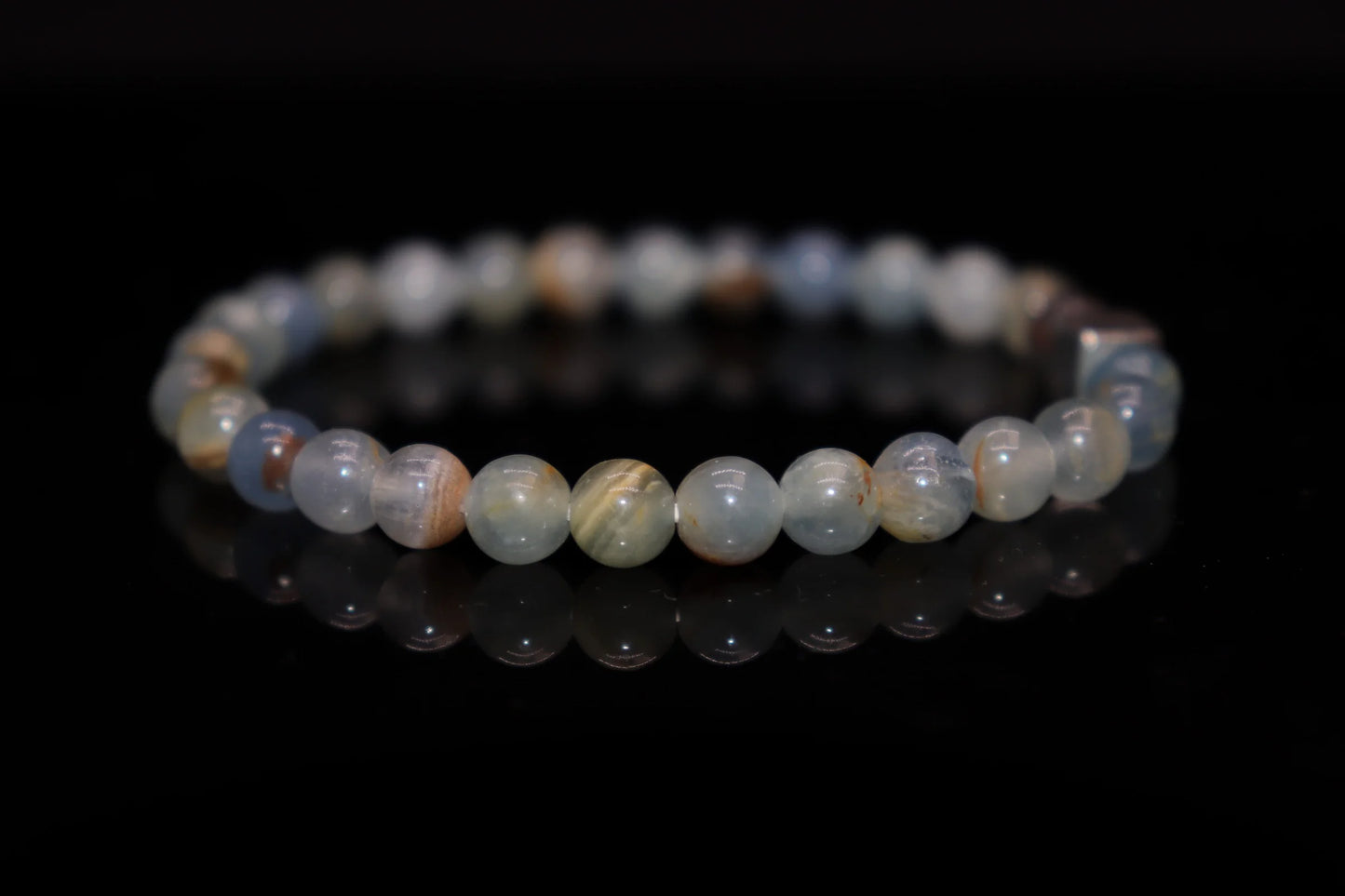
Calcite Silver Bracelet (6mm)
Couldn't load pickup availability
★ Custom - made according to your exact wrist size
★ Free shipping and returns
★ 30 - day satisfaction guarantee
★ Free resizing for new customers
Calcite beads (6 mm), paired with 925 Sterling Silver beads. Comes with a cotton pouch.
Calcite glows with a glassy lustre that turns softly pearly along its natural cleavage planes, in clear, colourless-to-white tones that seem lit from within. Turn a clear bead in your fingers and the world doubles – calcite's famous double refraction – while fine cleavage lines and tiny natural marks trace the mineral's own growth. Its gleam is lucid and cool, like light passing through ice, serene and quietly elegant, the clarity of a mind at rest.
Stone Stories
- A stone of double vision: the crystal that taught Europe to see light anew in 1669
- The mineral of the Parthenon and Michelangelo's David – marble is calcite in its rock form
- In ancient Egypt, calcite alabaster held the organs of the dead for their journey to the afterlife
- A "seeker's stone" – a quiet companion for finding your centre in a noisy world
One Stone, Two Worlds
Hold a clear piece of calcite to your eye, and the world doubles – every candle becomes two candles, every face two faces, as if the stone were quietly proving that what we see is never all there is. In the seventeenth century, this simple wonder taught Europe to see light anew; for two hundred years the clearest crystals of Iceland worked quietly inside the lenses of science, parting one ray of light into two, so that a single small stone could reveal what the eye alone never could. The same humble mineral built the temples of Athens and the columns of Rome; Michelangelo freed David from a single block of its marble; the Egyptians sealed their hopes for the afterlife in jars of it. It is a stone of seeing – of double vision, of hidden form waiting to be released, of the quiet belief that beneath every surface there is another world, patient and clear.
Cultural Allusions
- In 1669 the Danish scientist Erasmus Bartholin first described how a clear calcite from Iceland splits light in two – the double refraction that came to define the stone. In 1828 the Scottish physicist William Nicol built his famous prism from it, giving the world polarised light and the polarising microscope. The greatest crystals came from Iceland's Helgustadir mine – one specimen weighs 220 kg and rests in London's Natural History Museum; the site has been a protected natural monument since 1975.
- Marble is calcite in its rock form: the Parthenon was built from some 22,000 tonnes of Pentelic marble; about 80% of surviving Greek statues – including the Venus de Milo – were carved from Parian marble; and Augustus boasted that he "found Rome brick and left it marble".
- Michelangelo's David was released from a single block of Carrara marble that had lain discarded for decades; the master said he merely chipped away the excess stone to set free the figure imprisoned within. The Carrara quarries have been worked for over 2,300 years.
- In ancient Egypt, "alabaster" vessels of banded calcite held the mummified organs of the dead – the canopic jars of the afterlife, made from the Fourth Dynasty onward, for the soul was believed to need them in the world to come.
- In Chinese medicine, calcite has its own entry in the Bencao Gangmu of Li Shizhen: "because when struck it splits, piece by piece, into squares" – hence its name; it was prescribed, cold in nature, for heat in the chest, jaundice, and cleansing the blood.
Did You Know?
- Calcite is the standard mineral of hardness 3 on the Mohs scale – a steel knife scratches it easily.
- Place a clear piece over a page and the letters appear double – that is double refraction, calcite's signature trick.
- Marble, chalk and limestone – some of the most familiar rocks on Earth – are all made of calcite.
- The Parthenon, Trajan's Column and Michelangelo's David are all works of this one mineral.
- "Mexican onyx" is actually banded calcite travertine, not true onyx at all – a confusion that persists to this day.
Care
- Calcite is soft (Mohs 3) and brittle – store it separately, away from metal and harder gems.
- It dissolves in acids – keep it away from vinegar, lemon juice and household cleaners.
- Clean only with warm soapy water and a soft cloth; never ultrasonic or steam cleaners.
- Avoid heat, which can crack it; remove it for swimming and bathing; keep treated colours from strong light.
Wear your story.