My Store
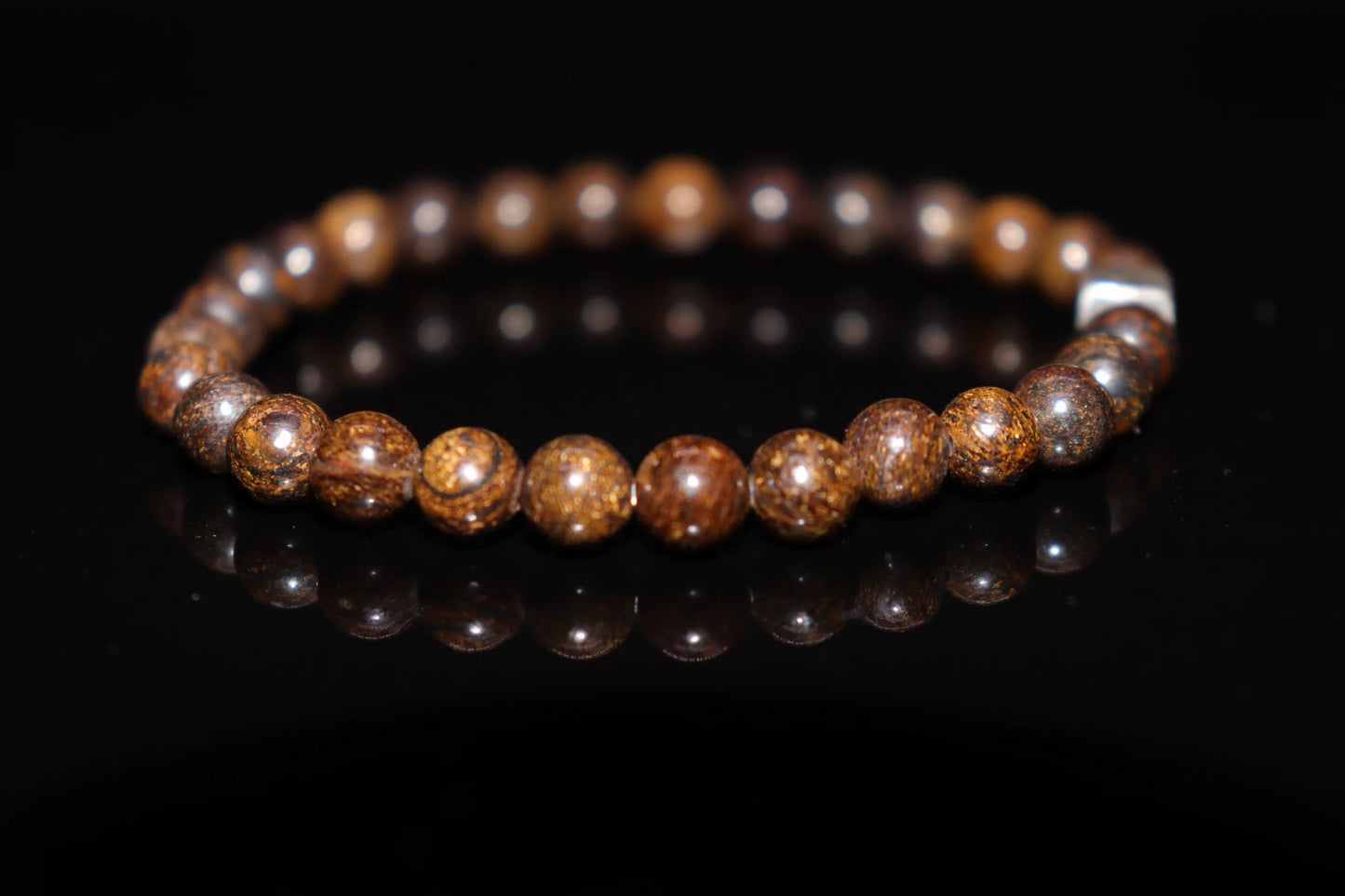
Copper Ore Silver Bracelet (6 Millimeters)
Copper Ore Silver Bracelet (6 Millimeters)
Couldn't load pickup availability
★ Custom - made according to your exact wrist size
★ Free shipping and returns
★ 30 - day satisfaction guarantee
★ Free resizing for new customers
Copper ore (bronzite) beads (6 mm), paired with 925 Sterling Silver beads. Comes with a cotton pouch.
Bronzite shows a greenish- to dark-brown tombac-brown base; polished beads carry a glassy to sub-metallic sheen, and as they turn, a bronze schiller lights up along the cleavage planes like silk sweeping through light. Within the beads, two sets of near-right-angle prismatic cleavages are clearly visible — the schiller itself comes from films of iron oxide that separated out along those planes, a natural record of the crystal's growth. The gleam is quiet and antique, deep and understated — bronze in its most dignified mood.
Stone Stories
- A bronze that is not bronze: bronzite is an iron-bearing variety of the pyroxene mineral enstatite, named around 1807 by the German mineralogist Karsten for its sheen "like dark bronze" — the gleam is real, the metal is not: it contains no copper
- Light caught between planes: the bronze shimmer (schiller) comes from films of iron oxide that have separated out along the crystal's cleavage planes — polished beads show a silky, metallic glow
- A stone that falls from the sky: olivine-bronzite chondrites are a major meteorite class — the "olivine-bronzite chondrites" of Prior's 1916 system are today's H chondrites
- The modern "grounding stone": today's crystal culture calls it the Grounding Stone, the Stone of Courtesy and the Stone of Focused Action — modern titles, for the mineral only received its scientific name in 1807
Dressed in Bronze
It wears the colour of copper and the name of bronze, yet holds not a trace of either metal. In its hidden cleavage planes, films of iron oxide have slowly separated out, catching the light like beaten metal — a gleam so like bronze that the German mineralogist Karsten named it bronzite around 1807, and so like copper that jewellery counters today call it "copper ore." No other stone is so honestly named: its very name confesses the resemblance — bronze-like, a pyroxene dressed in bronze. And this humble mineral keeps company with the stars: olivine-bronzite chondrites are among the most ancient rocks to fall from the sky. Stone that shines like metal, earth that falls from space — wear it, and wear an honest gleam at your wrist.
Cultural Allusions
- Named around 1807: the German mineralogist Dietrich Ludwig Gustav Karsten (1768–1810) gave it the name Bronzit for its dark-bronze sheen; Klaproth's 1807 paper in the Annales de chimie notes the mineral "had already been known for years under the name Bronzit" and carries the first chemical analysis (silica 60.00, magnesia 27.50, iron oxide 10.50) — from the serpentine of Kraubath, Styria; the "1817" dating found on some websites is wrong, for Karsten died in 1810.
- The English word arrived in 1816: according to the Oxford English Dictionary, the first English use of "bronzite" is in Parker Cleaveland's An Elementary Treatise on Mineralogy and Geology — two centuries of the name, all of it earned by the gleam of bronze.
- An early identity dispute: the great French mineralogist Haüy classed bronzite as a variety of diallage; Klaproth disagreed — bronzite would not fuse at all under the blowpipe, while diallage melted to slag; composition and behaviour, he argued, were different.
- A measure of the meteors: from the 1860s–80s (Rose 1863–64, Tschermak 1872 and 1883) bronzite and enstatite became core mineral markers in classifying meteorites; Prior's 1916 system named the "olivine-bronzite chondrites" — the H chondrites of today, among the commonest meteorites falling to Earth.
- The "copper" romance is a modern christening: bronzite contains no copper — the Venus and alchemy lore attached to copper belongs to the metal itself (copper is named for Cyprus, aes Cyprium, the island where Aphrodite came ashore); the shop-name "Copper Ore" borrows that romance without the metal.
Did You Know?
- The bronze gleam is iron, not bronze: films of iron oxide that separated out along the crystal's cleavage planes reflect the light — mineralogists call it schiller (German for "shimmer"), and the Chinese name, gǔtóng huīshí, means "ancient-bronze pyroxene."
- It belongs to the pyroxene family: a single-chain silicate, cousin of enstatite (named in 1855 from the Greek enstates, "opponent", because it refused to melt in the blowpipe flame) and of hypersthene — a name the IMA formally abolished in 1988 as redundant.
- It can become a star: gem-quality enstatite and bronzite from Sri Lanka show cat's-eye and asterism, the star usually four-rayed, occasionally six or eight — among the stone's most collectable forms.
- It is found in Antarctica — in meteorites: bronzite has been identified in meteorites found on the frozen continent, but treaty restrictions on mining mean it has never been extracted commercially there.
- In today's Chinese crystal circles it is classed as "earth element" and "Leo stone" — one source even calls it an August birthstone; such attributions are modern hobbyist lore and vary from source to source.
Care
- Hardness only 5–6 with well-developed cleavage: distinctly brittle — avoid drops and hard knocks, and take it off before sports and housework.
- No ultrasonic, steam or hot water: heat and vibration can damage cracks and the light wax/oil finish that many market beads carry.
- Keep it away from chemical cleaners and solvents, and from heat and sudden temperature changes.
- Clean with warm soapy water and a soft cloth or brush, rinse well and dry; store it alone in a soft pouch, away from harder gems.
Wear your story.