My Store
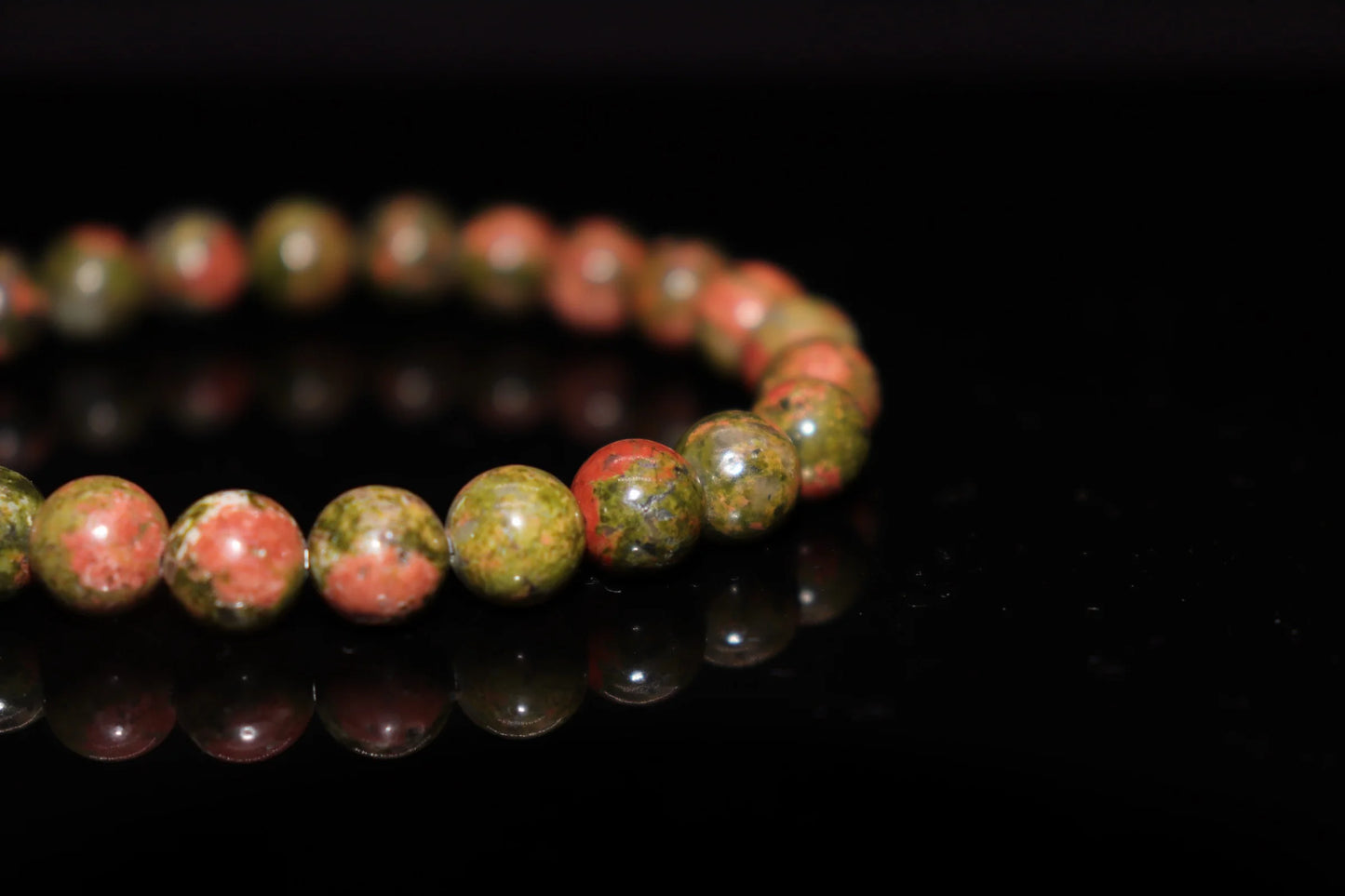
Dragon's Blood Jasper Silver Bracelet
Dragon's Blood Jasper Silver Bracelet
Couldn't load pickup availability
★ Custom - made according to your exact wrist size
★ Free shipping and returns
★ 30 - day satisfaction guarantee
★ Free resizing for new customers
Dragon's blood jasper beads (8 mm), paired with 925 Sterling Silver beads. Comes with a cotton pouch.
Natural dragon's blood jasper shows an opaque deep-green ground scattered with crimson-to-dark-red patches, and takes on a vitreous luster once polished. Inside, columnar epidote crystals interweave with grains of piedmontite and iron oxides in a naturally mottled pattern — the natural imprint of metamorphic rock more than two billion years old. Its glow is like old blood spilled across a mossy field: deep, rugged, carrying the raw texture of the deep earth itself.
Stone Stories
- The oldest red name in trade: "dragon's blood" entered history as a plant resin — recorded in the 1st-century Periplus Maris Erythraei, traded from the island of Socotra for two thousand years — and only in recent decades did the name pass to the stone at your wrist
- Blood written in minerals: the crimson spots are piedmontite — a manganese-bearing cousin of epidote — or iron oxides; the green ground is epidote or chromium-bearing fuchsite — the palette of deep earth, with no drop of the dragon in it
- From the iron country: the classic material comes from Western Australia's Pilbara region, cut from metamorphic rock more than two billion years old — first quarried as decorative stone within one of the world's great iron mines
- The modern Stone of Courage: crystal culture calls it the Stone of Courage and the Warrior's Stone, bound to European dragon legend — titles and fame both minted in our own century, for no ancient text knows this stone
Named for Dragon's Blood
No dragon ever bled here — yet the name is two thousand years old. Before the first bead was ever cut, "dragon's blood" belonged to another red: a deep resin of the dragon trees of Socotra and the rattan palms of Southeast Asia, traded along the spice roads since the first century, a scarlet pigment, a medicine and a spice by turn, and trusted as varnish by the violin makers of Cremona — while medieval encyclopedias swore it was the blood of dragons and elephants slain in battle. Only in our own century did the ancient name pass to a younger stone: green epidote and crimson piedmontite from the iron country of Western Australia, cut from rock more than two billion years old, its red written not by any wound, but by iron and manganese across the slow ages. The oldest red in trade, and a stone far older than its legend. Wear it, and wear a tale that has outlived every dragon.
Cultural Allusions
- The resin came first: from the first century, "dragon's blood" was a deep red resin — of the dragon trees of Socotra (Dracaena cinnabari) and the rattan palms of Southeast Asia — recorded in the Periplus Maris Erythraei; by the Middle Ages, encyclopedias swore it was the blood of dragons and elephants slain in battle
- A red that served kings and violin makers: for two thousand years the resin was a scarlet pigment, a medicine and a spice — 18th-century Cremona violin makers trusted it as varnish, and in China it dyed the red papers of weddings and the New Year
- The Romans' ancient confusion: antiquity itself muddled "dragon's blood" with cinnabar — Rome's naturalists tangled the red resin with the mercury red, and the name has been knotted with reds ever since
- Born inside an iron mine: the Australian material was first worked as decorative stone within an iron mine of the Pilbara — the iron province whose ancient formations are more than two billion years old, with dealers placing the classic find near Turee Creek
- A dragon for the modern wrist: the stone reached the market only in recent decades, yet it travels with Europe's oldest stories — the Swedish house AWNL built a "dragon-slaying" bracelet around it, pairing the beads with a fragment of ancient meteorite, and John Hardy has set dragon's blood jasper in men's silver
Did You Know?
- Not a jasper, though it answers to the name: the "jasper" is a trade courtesy — mineralogically it is an epidote-family rock, not the microcrystalline quartz of true jasper; denser than quartz, a bead of it feels distinctly heavier in the hand than a real jasper of the same size
- A legend younger than the internet: no ancient text or medieval lapidary mentions this stone — its dragon tale was coined by the modern crystal trade, and the name went global only in the 2010s
- Two "blood" stones that share only a word: the Chinese seal stone 鸡血石 is red from cinnabar (mercury sulfide, hardness 2–2.5), while this stone's red is piedmontite or iron oxides in a hard silicate of 6.5–7, free of mercury
- The red that outlived its painters: the ancient "dragon's blood" resin is still listed among natural red dyes (C.I. Natural Red 31) — the same red that dyed Chinese wedding and New Year papers and coated the violins of Cremona
- From the heart of an iron mine: the classic Australian material comes from metamorphic rock more than two billion years old, first quarried as decorative stone within an iron mine of the Pilbara; the South African material from Limpopo is a far more recent find
Care
- Clean gently: wipe with a soft dry cloth, or a slightly damp cloth if needed — no soap, detergent or chemical cleaners; let it dry before wearing.
- Keep the cord dry: the elastic thread dislikes soaking — take the bracelet off before bathing, swimming, hot springs and washing-up, for salt and chlorine age the cord.
- Steer clear of chemicals and harsh light: avoid perfume, lotion, hairspray and household chemicals, and keep the stone from long direct sun and sudden changes of temperature and humidity, which can dull its colours.
- Silver wants its own care: the 925 silver bead will tarnish in time — polish it with a silver cloth, and store the bracelet in a dry, sealed pouch with the beads wrapped in soft cloth.
Wear your story.