VISAXUM
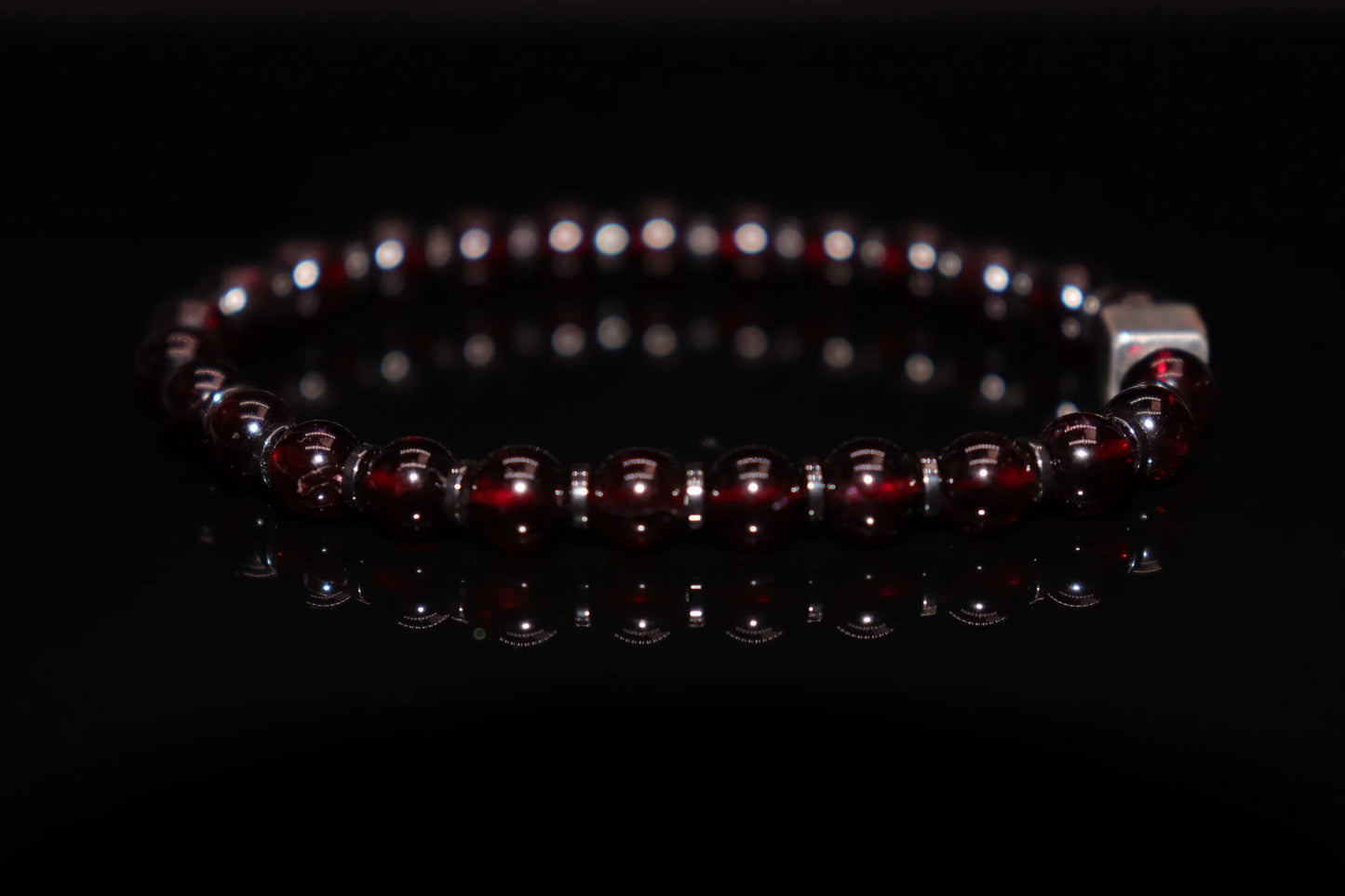
Garnet Silver Bracelet (6mm)
Garnet Silver Bracelet (6mm)
Couldn't load pickup availability
★ Custom - made according to your exact wrist size
★ Free shipping and returns
★ 30 - day satisfaction guarantee
★ Free resizing for new customers
Garnet beads (6 mm), paired with 925 Sterling Silver beads. Comes with a cotton pouch.
Deep red garnet beads glow with a rich wine-red body colour and a bright vitreous lustre; as they turn, light glints across the beads like light on glistening pomegranate seeds. Inside, fine natural rutile needles cross in pairs at about 70°/110° – growth marks the mineral made on its own. The glow is warm like a little burning coal – deep, steady and quietly radiant against the wrist.
Stone Stories
- Named for the pomegranate – the Latin granatum, "the seeded apple": deep red crystals likened to its glistening seeds
- The Romans called it carbunculus, "a little burning coal" – Pliny recorded that such stones would not fear the fire
- The seed of the Persephone story: the pomegranate kernels that bound her to return each year – a promise of coming back
- The "traveller's stone" of medieval Europe – carried by those setting out, and given between friends as a pledge of reunion
- The January birthstone, officially adopted in 1912, and the gem of the second wedding anniversary
The Ember in the Seed
The Romans named it carbunculus – "a little burning coal" – and Pliny wrote that it would not be conquered by fire, that in the dark it could melt the very wax of a sealed letter. The oldest word for it is fire; the name we still use is seed. Garnet descends from granatum, the pomegranate, that "apple of many seeds," and the small deep-red crystals were likened to its glistening kernels – the same kernels Persephone ate in the underworld, binding her to return to it each year, the oldest story of a seed that keeps its promise of coming back. So this stone holds two ancient thoughts in one small red body: fire that does not die, and a seed that always returns. Victorian lovers gave it as a pledge of constancy; the people of Bohemia built towns, schools and museums around it, until it became the emblem of a nation. Wear it, and carry both at once – a seed of fire, warm against the wrist, that remembers the dark it was born in and returns from it, glowing.
Cultural Allusions
- The name garnet descends from the Latin granatum – the pomegranate – through the Old French grenat, entering English around the 14th century, because the deep red crystals resemble the fruit's seeds. In the Homeric Hymn to Demeter (7th–6th century BC), Persephone eats pomegranate seeds in the underworld and so must return to it each year; no ancient text mentions the gem itself – the link is the shared name, "seed," and modern gem reference books join the two by etymology.
- Pliny the Elder, in his Natural History, called fire-red stones carbunculus – "a little coal" – recording a dozen varieties, their lands of origin, the "male and female" stones, the belief that they would not fear the fire (acaustoi), and the tale that in darkness they could melt sealing wax. The Romans also carved garnets into signet rings for stamping their wax seals – such rings survive in the British Museum, the Metropolitan Museum and the V&A.
- In 1939 the Sutton Hoo ship burial in Suffolk, England (c. AD 610–635, thought to be King Raedwald's tomb) yielded masterpieces of early medieval cloisonné – shoulder clasps, a purse lid, belt fittings – in which thousands of cut garnets sit in golden cells, foil-backed to flash light. In 2023 the British Museum's particle-accelerator analysis showed those garnets came from India, Sri Lanka and Bohemia: proof of a 7th-century gem road linking England to the wider world.
- Bohemian garnet – the chromium-rich pyrope of today's Czechia – has been mined since around the 5th century. In 1762 the Empress Maria Theresa banned the export of rough stones to protect her cutters; in the 19th century Turnov became its cutting capital, home since 1883 to Europe's oldest gem-cutting school, where thousands of artisans set tiny rose-cut garnets in silver in the pavé style that swept Europe. Scholars came to call Bohemian garnet "the mineralogical symbol of Bohemia."
- Garnets were among the most fashionable gems of the Victorian age (1837–1901) – GIA records them as "extremely popular," and the old carbuncle cabochon was revived. At the same time the green demantoid garnet was discovered in 1868 in the Ural Mountains; its fire exceeds even the diamond's, which is how it earned the German name Demant – and it became a favourite of the Russian imperial court and of Fabergé.
Did You Know?
- Garnet is not one mineral but a family – over twenty species covering nearly every colour: red almandine and pyrope, green tsavorite and demantoid, orange spessartine, purple rhodolite.
- Garnet is single-refraction, showing no pleochroism – the quickest way to tell it from ruby – and iron-bearing garnets are even faintly attracted to a strong magnet.
- Most garnets are completely untreated: the colour is natural, one of the family's greatest virtues compared with ruby and sapphire.
- China's jewellery trade once called deep red garnet ziya wu (紫牙乌), believed to come from the Arabic yakut, "ruby," with zi ("purple") added for its purplish-red tone.
- Idaho's state gem is the star garnet: at Emerald Creek, the public is invited to dig for their own four-rayed stars on federal land.
Care
- Clean with warm water, mild soap and a soft brush; ultrasonic cleaning only for stones without cracks or fillings; steam cleaning is not recommended.
- Garnet is attacked by hydrofluoric acid – keep it away from such chemicals, and avoid prolonged heat and sudden temperature changes.
- At 6.5–7.5 on the Mohs scale it is softer than ruby, sapphire and diamond: avoid knocks, and store it apart from harder gems.
- For large demantoid and other special stones, ask for a certificate – low-temperature heating and resin filling are occasionally seen in the trade.
Wear your story.