My Store
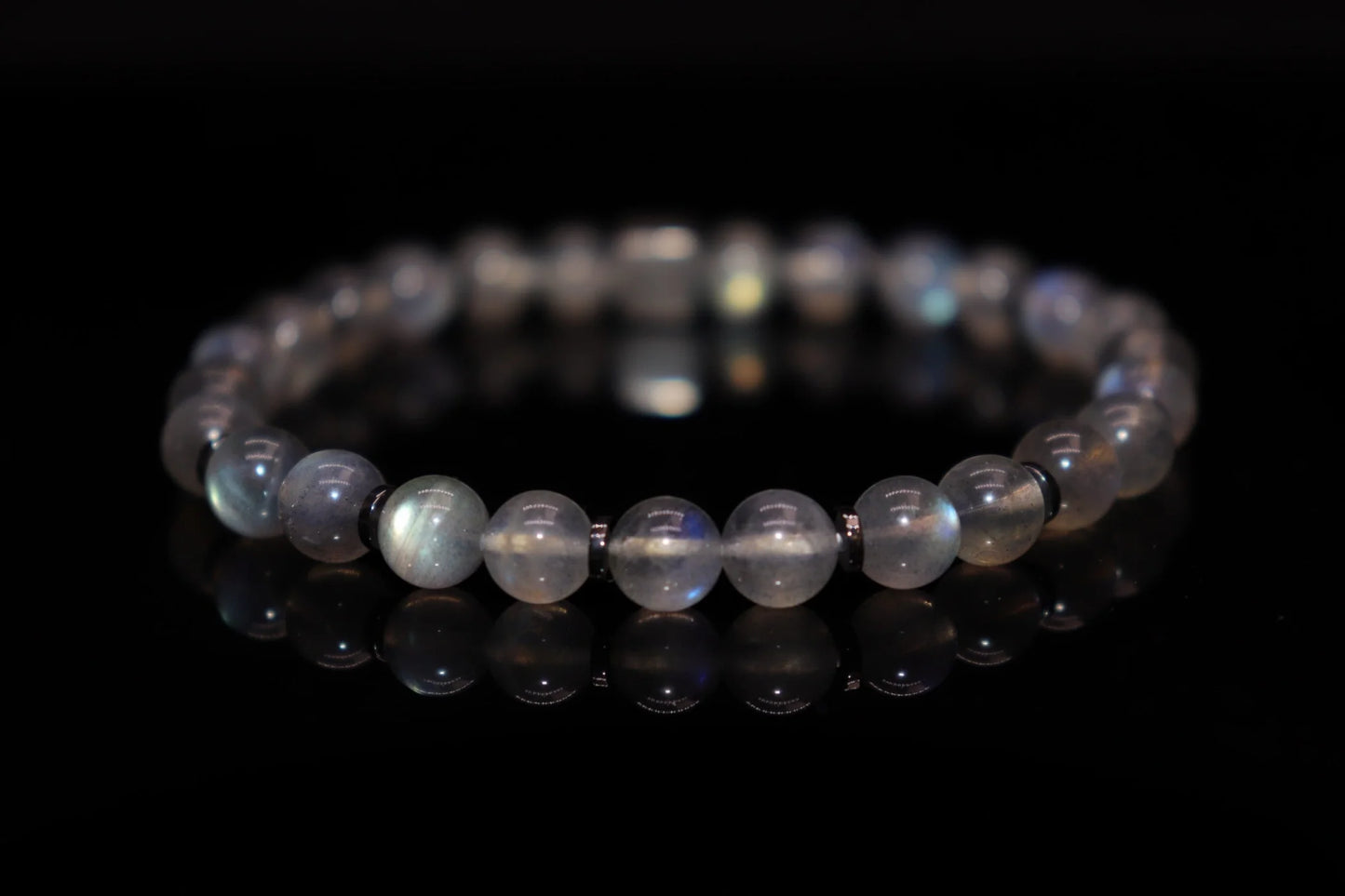
Grey Moonstone Silver Bracelet (6 Millimeters)
Grey Moonstone Silver Bracelet (6 Millimeters)
Couldn't load pickup availability
★ Custom - made according to your exact wrist size
★ Free shipping and returns
★ 30 - day satisfaction guarantee
★ Free resizing for new customers
Grey moonstone beads (6 mm), paired with one 925 Sterling Silver logo bead. Comes with a cotton pouch.
- The "New Moon Stone": in crystal traditions the smoke-grey moonstone stands for the quiet potential of the crescent moon – while white moonstone is its full moon
- In India it is chandrakanta, "the beloved of the moon": moonlight believed to have solidified into stone
- In Rome it was a "drop of moonlight", sacred to Diana and Luna; Romans have worn moonstone jewellery since AD 100
- One of the three June birthstones (with pearl and alexandrite), and the state gem of Florida since 1970 – chosen the year after Apollo 11 touched the moon
The Hour of the New Moon
In India they call it chandrakanta – the stone the moon loves – believing it is moonlight that chose to become solid. The Romans called it a drop of moonlight and thought they could see the goddess Diana moving inside it. Of all the moonstones, the grey one belongs to the newest moon: that silver-grey hour when a thin crescent hangs barely brighter than the dark around it, and everything is still possible. It is called the New Moon Stone – not the fullness, but the promise of fullness; the beginning that has not yet spoken. In Sri Lanka it is still raised from hand-dug shafts ten to forty metres deep, where miners wash the gravel only on auspicious days. Wear it, and carry the quietest hour of the night – the hour before the first light, when every beginning is still unwritten.
Energy Properties
- Called the "New Moon Stone": believed to carry the energy of the new moon – the potential of things not yet manifest – and worn when setting intentions
- Believed to sharpen intuition and self-awareness, soothe the emotions, and help release what is held too tightly
- Believed to ease sleeplessness, anxiety and irritability, and to restore inner calm and emotional balance
- Called the "Shamanic Moonstone": believed to be a stone of inner reflection and deep seeing, for what lies behind the veil
Cultural Allusions
- In India the moonstone is chandrakanta – Sanskrit for "beloved of the moon": the moon is believed to love it, its light waxing and waning with the moon itself. The old traditions held that, kept in the mouth at full moon, it let one glimpse the future, and it was given as a wedding gift to bless the harmony of marriage.
- Chandra, the moon god of Hindu tradition, is believed to wear a moonstone on his forehead – the stone became his representative on Earth; in the alchemical Rasa-jala-nidhi it is written that chandrakanta weeps drops like nectar under moonlight, which is why the moon god is also called the "lord of nectar".
- The Romans saw in it "drops of moonlight" and a gift from Diana and Luna; some believed the goddess herself could be seen within the stone. Pliny held that it brightened and dimmed with the moon – a belief that survived in Europe until the sixteenth century.
- The finest blue sheen comes from Sri Lanka's Meetiyagoda mine, discovered in 1906 by a kaolin merchant – a hand-dug labyrinth of coconut-wood-lined shafts, ten to forty metres deep, where the gravel is washed only on auspicious days. Sri Lankan moonstone was once sold as "Ceylon opal".
- In the Art Nouveau years René Lalique set moonstones into dreamlike jewellery – his 1897–98 Dragonfly-Woman corsage ornament among them, and a Lalique moonstone watch sold for some €697,000 at Sotheby's in 2013; Louis Comfort Tiffany paired moonstone with Montana sapphires, and Georg Jensen's "Moonlight Blossom" silver series is still made today.
Did You Know?
- Moonstone is a meeting of two feldspars: submicroscopic layers of orthoclase and albite scatter light between them – the floating blue sheen (adularescence) is strongest when you look at the stone at a right angle.
- Grey and white moonstone are the same mineral, differing only in body colour; much "grey moonstone" on the market is actually labradorite – GIA notes that "rainbow moonstone" is always labradorite.
- Pliny held that moonstone waxed and waned with the moon – a notion that endured into the 16th century, though scholars doubt the ancients' "selenitis" was today's moonstone at all.
- Sri Lankan moonstone was once sold under the name "Ceylon opal"; its deep blue sheen commands the highest prices in the world.
- A moonstone in the collection of Pope Leo X was believed to grow brighter and dimmer with the phases of the moon – an anecdote long kept in gem lore.
Care
- Moonstone is soft (Mohs 6–6.5) and has two perfect cleavages, so it asks for gentle handling – store it separately, and never knock it against hard objects.
- Clean only with warm water, mild soap and a soft brush; never ultrasonic or steam cleaners – vibration and heat can crack it.
- Remove it for sport and heavy work; on a bracelet, watch for hard knocks against tables and doorways.
- Keep it out of prolonged direct sunlight and store it in a soft pouch, away from harder gems.