My Store
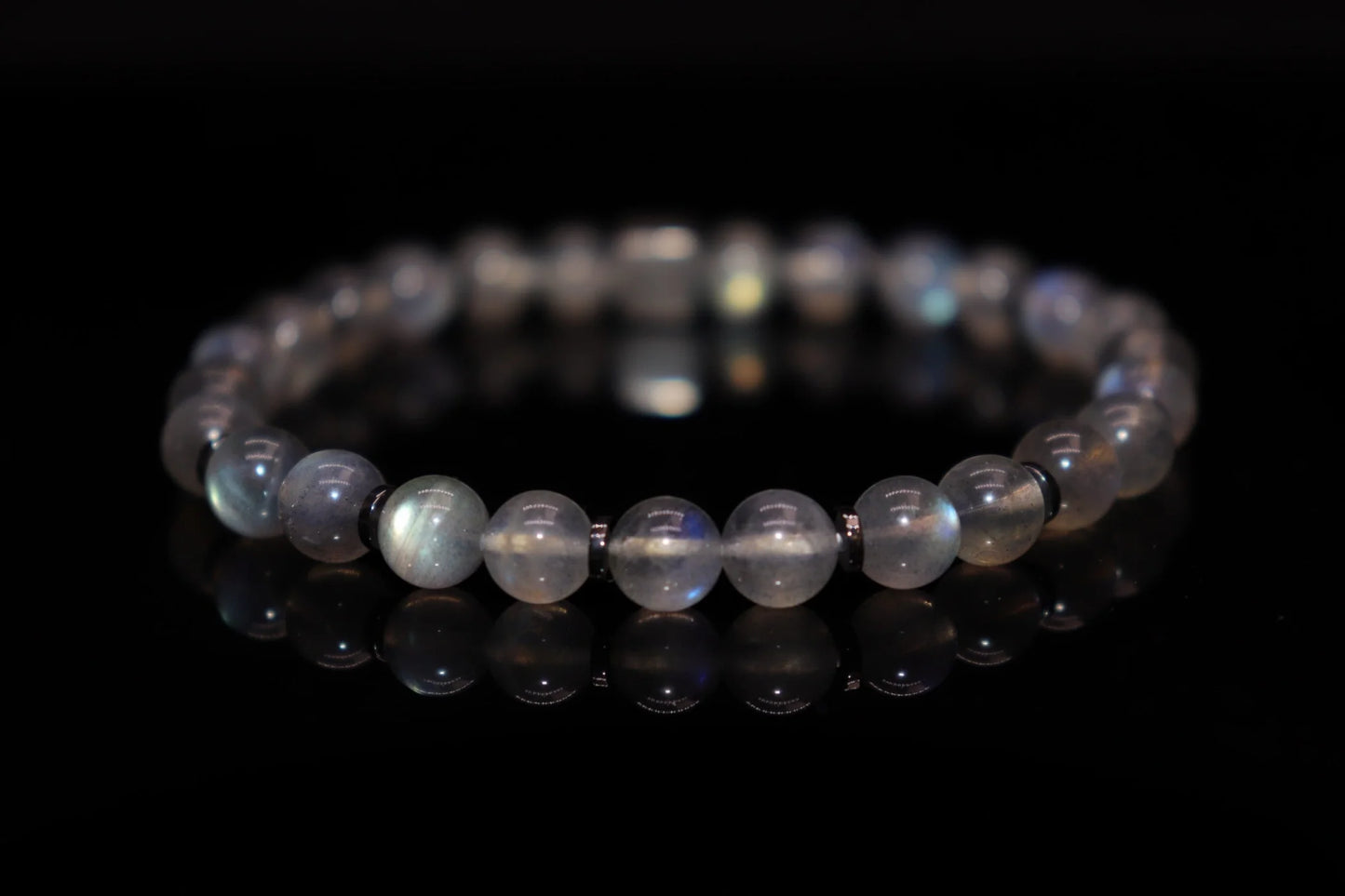
Labradorite Silver Bracelet (8mm)
Labradorite Silver Bracelet (8mm)
Couldn't load pickup availability
★ Custom - made according to your exact wrist size
★ Free shipping and returns
★ 30 - day satisfaction guarantee
★ Free resizing for new customers
Labradorite beads (8 mm), paired with 925 Sterling Silver beads. Comes with a cotton pouch.
Natural labradorite has a deep smoky-grey body; turn the bead to the light and the stone opens – a flash of electric blue, now green, now a thread of gold, like the northern lights caught mid-ripple. Within lie fine dark flecks and the lamellae of two feldspars intergrown – the natural signature of the stone. The gleam is like the aurora behind glass: vivid, layered and utterly distinct from any softer moonstone glow.
Stone Stories
- The "Aurora Borealis stone" – in Inuit legend the northern lights were imprisoned in the rocky coast of Labrador; the flashes still held in the stone are that same light
- Named after Labrador, Canada: found by Moravian missionaries around 1770 and named by the mineralogist A. G. Werner in 1780
- The official mineral emblem of Newfoundland and Labrador
- In Finland it was found in 1940 during wartime fortification works and named "spectrolite" – the stone whose colours span the whole spectrum
- Its distinctive blue-green flash is called labradorescence – a phenomenon unique to the feldspar family, different from the soft glow of moonstone
The Frozen Aurora
In the far north they tell it this way: long ago the northern lights were shut inside the rocks of the Labrador coast, and when a hunter's spear struck the stone the lights leapt up and burst back into the sky – and what could not escape stayed behind, sleeping in the stone. That is why, even today, each bead keeps a thread of aurora. Turn it to the light and the colour breathes: blue, green, gold – opening and closing as the light moves, like the sky over a snowfield before dawn. Called the stone of transformation in crystal traditions: not the end of a thing, but the light that was never lost. Wear it, and carry the moment the sky caught fire – and kept a little fire back.
Cultural Allusions
- The name comes from Labrador, Canada, where the Moravian missionaries found the stone as boulders on the coast around 1770; specimens were sent to London, and in 1780 the mineralogist Abraham Gottlob Werner gave it the name labradorite.
- The Inuit legend holds that the northern lights were imprisoned on the rocky coast of Labrador – in many tellings, a hunter struck the rocks with his spear, releasing the lights into the sky; what remained stayed in the stone, and still shines there.
- In 1940, during the building of wartime fortifications in Ylämaa, Finland, Pekka Laitakari found a stone that flashed a whole spectrum of colour; his father, the geologist Aarne Laitakari, named it spectrolite.
- The darkest, clearest stones flash brightest – black-bodied stones with high-saturation blue are the most prized, followed by green and gold; orange, red and violet flashes are rare, and stones that show several colours at once rarer still.
- The "blue eyes" of the stone are a trick of light, not pigment: submicroscopic layers of two feldspars interfere with light as an oil film does on water – which is why labradorite must be cut in a particular direction to flash.
- Labradorescence was named by the Danish mineralogist Ove Bøggild, whose early-twentieth-century studies showed that only layers of the right submicroscopic thickness – a few hundred millionths of a millimetre – produce the colour.
Did You Know?
- The flash of labradorite is called labradorescence – a play of light from submicroscopic layers of two feldspars intergrown; it is a different phenomenon from the soft floating sheen of moonstone (adularescence).
- In the trade, "rainbow moonstone" is actually transparent labradorite – GIA notes it is "known in the trade as rainbow moonstone" though it is not a moonstone at all.
- Much of what the Chinese market calls "grey moonstone" is in fact labradorite – the two minerals sit in different branches of the feldspar family.
- Named in 1780 by the mineralogist A. G. Werner, the stone was long believed to be its own mineral species before it was recognised as part of the feldspar family.
- In The Hobbit films, Kili's rune stone – carved with the words "Return to me" – was said to be made of labradorite.
Care
- Labradorite is relatively soft (Mohs 6–6.5) with two perfect cleavages, so the best home for it is in earrings and pendants; on a bracelet, be gentle.
- Clean only with warm water, mild soap and a soft cloth; never ultrasonic or steam cleaners – vibration and heat can crack it.
- Remove it for sport and heavy work; avoid knocks against tables, doorways and hard objects, and keep it away from harder gems.
- Keep it away from perfume, cosmetics and pool or spa water; store it in a soft pouch, away from prolonged sunlight.
Wear your story.