VISAXUM
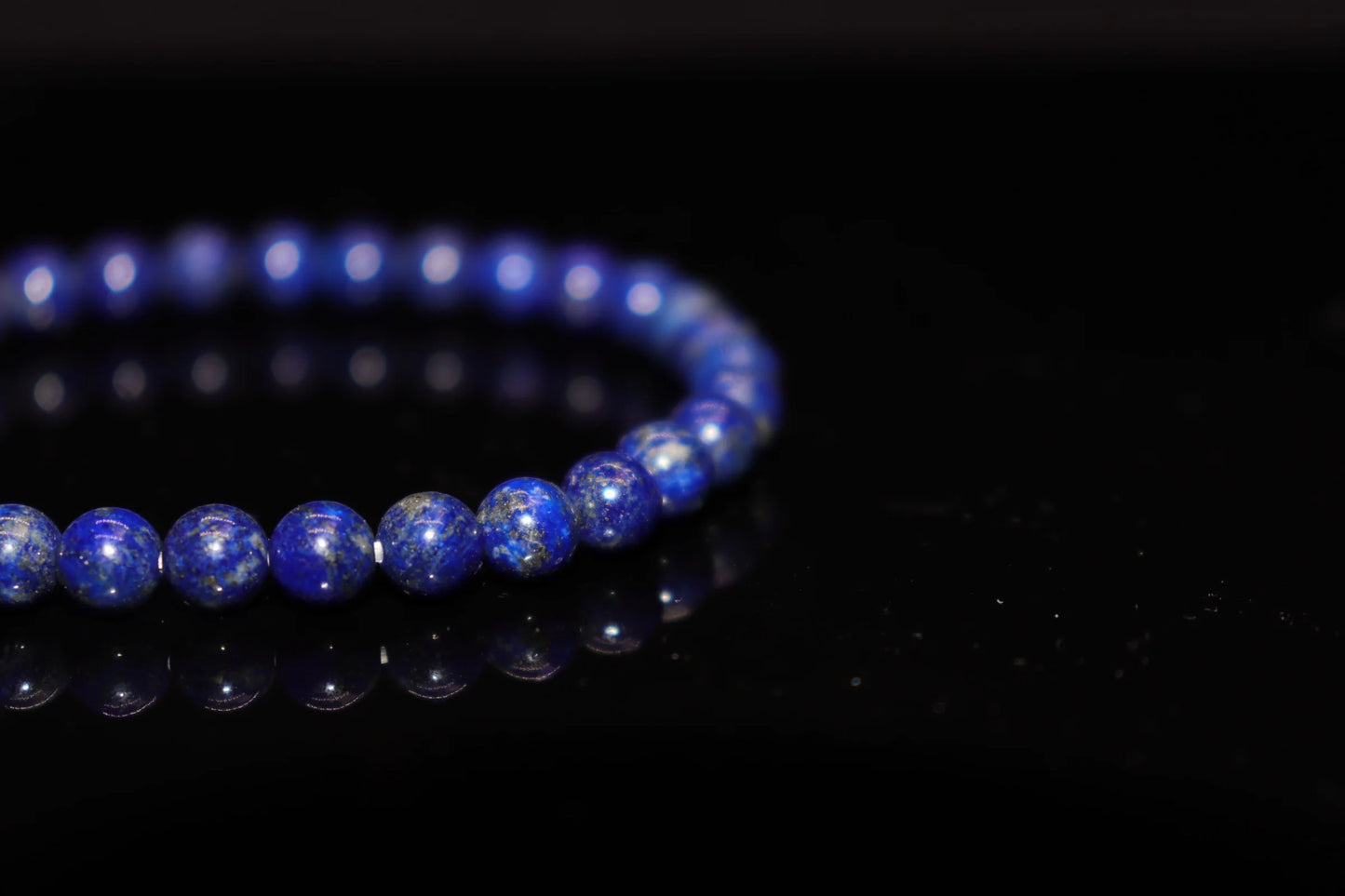
Lapis Lazuli Silver Bracelet (6mm)
Couldn't load pickup availability
★ Custom - made according to your exact wrist size
★ Free shipping and returns
★ 30 - day satisfaction guarantee
★ Free resizing for new customers
Lapis lazuli beads (6 mm), paired with 925 Sterling Silver beads. Comes with a cotton pouch.
Lapis lazuli is opaque, with a deep royal blue to violet-blue base; the polished beads carry a soft, even luster, and as they turn, golden pyrite flecks glint across the deep blue like stars in a night sky. White calcite patches mingle naturally with the pyrite within the beads — the blue itself comes from sulphur groups in the lazurite structure, and the mottling is simply how the stone grew. The blue is deep, the glow is steady — quiet, regal, and serene.
Stone Stories
- A masterpiece of many minerals: lapis lazuli is built of deep-blue lazurite, flecked with golden pyrite and touched with calcite — a natural mosaic whose blue, born of sulphur groups in lazurite, never fades, even ground into the pigment of Renaissance masters
- Called the "stone of wisdom" and "stone of truth": the Egyptians called it khesbedj – a piece of the night sky, its golden flecks the stars themselves
- The blue that carried a name: the ancient Greeks' sappheiros and the Bible's sappir meant lapis lazuli, not sapphire — Pliny's sapphirus was "never transparent, speckled with gold, from Persia," which is exactly our stone
- Six thousand years at Sar-e-Sang: the Afghan mine at Badakhshan has been worked for more than six thousand years and is listed by IUGS as an international geoheritage site — the "Lapis Lazuli Road" that carried it west was the world's earliest long-distance gem-trade route
- Ground fine, it became ultramarine – the most precious blue of Renaissance painting, worth more than gold, reserved for the Virgin's robe
A Piece of the Night Sky
For the Egyptians it was khesbedj — a piece of the night sky, its golden flecks the stars themselves. Legend says the gods' hair was woven of it; queens and pharaohs wore it into death and rebirth. Six thousand years ago, miners in the mountains of Badakhshan were already working the same stone that would one day sit on the mask of Tutankhamun — and the "Lapis Lazuli Road" that carried it west was the world's first great gem-trade route, centuries older than the Silk Road that would later absorb it. Ground fine, it became ultramarine, the most precious blue of Renaissance painting, worth more than gold, reserved for the robe of the Virgin and the sky of heaven. And in the oldest myth of all, the goddess Inanna threaded lapis beads at her neck before descending into the underworld — seven gates, seven jewels taken, one by one. Wear it, and wear the night sky itself: ancient, star-flecked, unshaken.
Cultural Allusions
- The goddess's descent: in the Sumerian epic of Inanna (Oxford ETCSL texts), the goddess strings fine lapis beads at her neck before her descent to the underworld — at each of the seven gates a piece of her regalia is taken away, including the lapis bead necklace; lapis gates, thrones and crowns fill the same ancient texts.
- Tutankhamun's mask: found in 1922, the golden death mask uses lapis for the eyebrows, the cosmetic eye-lines, the blue stripes of the nemes headcloth and the vulture-and-cobra figures at the brow — the lapis came from Afghanistan through the Near Eastern networks of royal gifts.
- Queen Puabi of Ur (c. 2600–2500 BC): excavated in 1928, her headdress combined twenty gold leaves, two strings of lapis and carnelian beads and a large gold comb weighing over six pounds; lapis from Afghanistan and carnelian from the Indus Valley bear witness to trade across the width of Asia.
- Ultramarine for the Madonna: from the late 13th century the pigment cost as much as gold, sometimes several times more; Michelangelo bought it in quantity for the Sistine Last Judgement, and when the pope complained the fresco lacked gold and ultramarine, Michelangelo answered that the apostles would despise such luxury (as Vasari tells it).
- Vermeer's heated blue: the 2020 "Girl in the Spotlight" study proved that the headscarf of Girl with a Pearl Earring (c. 1665) was painted with high-quality natural ultramarine — some of it from lapis heated to 600–750 °C to deepen its blue — modern science reading a 350-year-old painter's recipe.
- In China, the "stone whose colour is like heaven": kept for fourth-rank hat finials and the emperor's rites at the Temple of Heaven.
Did You Know?
- The blue is sulphur: the deep colour of lazurite comes from sulphur radicals (such as S₃⁻) in its structural channels — no copper, no iron — which is why lapis blue survives centuries and sunlight untouched.
- The "night sky" effect is pyrite: golden pyrite flecks are the classic signature of fine lapis; the best grades show fine, even stars, while a perfect "ultramarine" grade may show almost none at all.
- The ancients' "sapphire" was lapis: Pliny's sapphirus was "never transparent," speckled with gold, from Persia — the transparent blue sapphire we know entered Europe's gem lists much later; hence the Bible's sappir and the breastplate stone of Exodus are read by scholars as lapis.
- A blue that named a colour: the Persian name of the stone, lājvard, gave the world "Persian blue" — and the deep-blue glazed tiles that crown Iranian mosques since the 12th century are called lajvardina after it.
- Worn on royal wrists and watch dials: Cartier's Amulette series makes lapis the emblem of serenity, and Bulgari's Cameo Imperiale watch dresses an Augustus cameo in a lapis toga — while tradition names lapis the gemstone of the ninth wedding anniversary.
Care
- Away from acid: lapis contains calcite, so keep it clear of sweat, vinegar, lemon and household cleaners.
- Away from moisture: the stone is fine-grained and porous — sweat, perfume, cosmetics and seawater may seep in; take it off before sport, swimming, bathing and cooking.
- Clean only with warm soapy water and a soft brush, drying at once — never ultrasonic or steam cleaners, and keep it from heat and long sun.
- Keep it in its soft pouch, away from harder gems: lapis asks for gentle company; when cleaning the silver bead, remove the bracelet or shield the lapis beads first.
Wear your story.