My Store
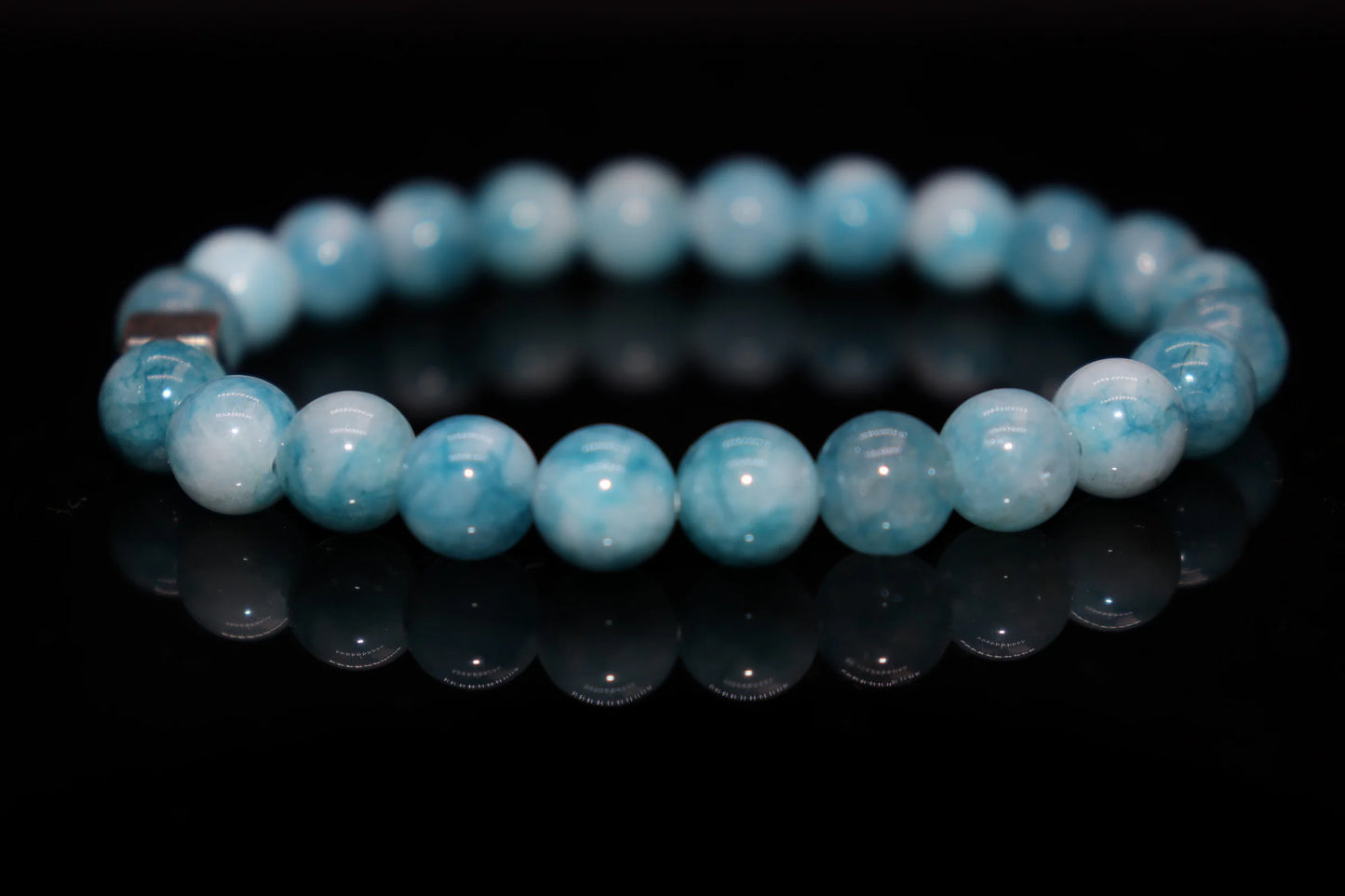
Larimar Silver Bracelet (8mm)
Larimar Silver Bracelet (8mm)
Couldn't load pickup availability
★ Custom - made according to your exact wrist size
★ Free shipping and returns
★ 30 - day satisfaction guarantee
★ Free resizing for new customers
Larimar beads (8 mm), paired with 925 Sterling Silver beads. Comes with a cotton pouch.
Larimar is opaque to slightly translucent, its sea-blue to blue-green surface showing a silky to subvitreous lustre that turns and flows as the beads move. Inside, a radiating mass of fine fibrous crystals catches the light in larimar's signature "sea-wave" pattern, with natural pores and the interplay of blue and green tones left by the mineral's own chemistry. Its gleam is like sunlight moving across a Caribbean sea – deep, tranquil and quietly luxurious, carrying the calm of an island afternoon.
Stone Stories
- Found in only one place on Earth – the Barahona mountains of the Dominican Republic
- A stone of the water element: born where volcano met sea, and named for the sea itself
- Called the "stone of water consciousness" – its blue is the calm of a Caribbean afternoon
- The people of Barahona long called it Piedra Azul, "the blue rock", believing it came from the sea
- Linked with the throat chakra – the seat of honest, clear and warm expression
Fire Met the Sea, and Named It After a Daughter
Deep in the mountains of Barahona, volcanic rock and ancient sea once met in a long, quiet embrace, and the stone that grew there remembers both – white veins of foam drifting through a blue so clear it seems to hold the whole Caribbean sky. For centuries the people of the coast simply called it "the blue rock", believing it came from the sea, for the river carried its fragments down to the shore. In 1974, two men walking that beach picked up a shard of it, followed the river upstream, and found the mountain where it lived. The father named it after his daughter, Larissa, and after the sea – mar – whose colour it wears. Larimar. Only one place on Earth holds it. To wear it is to carry a small piece of that island story on your wrist: fire and water made friends, a father's love turned into a name, and the blue of an entire sea, caught in stone.
Cultural Allusions
- In November 1916, a Catholic priest of Barahona, Father Miguel Domingo Fuertes Loren, discovered the blue rock in the Bahoruco mountains and applied for a mining licence – but the application was rejected, and the discovery was forgotten for more than half a century.
- In 1974, Peace Corps volunteer Norman Rilling and the Dominican Miguel Méndez found blue stones washed up on the beach where the Bahoruco River meets the sea, traced them upstream to the source, and opened the Los Chupaderos mine – still the world's only larimar deposit. Méndez named the stone for his daughter Larissa and the Spanish mar, "sea".
- By Law No. 296-11 of 2011, larimar was made the national stone of the Dominican Republic; in 2018 the 22nd of November became the National Larimar Day. In 2018 the country also granted it the appellation "Larimar Barahona" – its first stone product to receive a denomination of origin – registered internationally through WIPO in 2025 across 28 countries.
- Long before it had a name, the people of Barahona called it Piedra Azul – "the blue rock" – and believed it came from the sea, because the river carried it down to the beach.
- Its blue is not what it once seemed: a 2023 study showed the colour comes chiefly from vanadium (V⁴⁺), not copper as long believed – and the stone itself is geologically young, formed less than about 400,000 years ago.
Did You Know?
- Larimar is not a mineral of its own but a blue variety of pectolite – and the whole world's supply comes from a single small deposit in the Dominican Republic.
- Its colour was long attributed to copper; a 2023 mineralogy study found the blue is actually due to vanadium, with iron adding the green tones.
- It is a young stone: less than about 400,000 years old, while most gems count their age in millions.
- Cutting larimar is costly – the stone is full of cracks, and as much as 90% of the rough can be lost in the workshop.
- The nickname "Atlantis Stone" comes from a 20th-century prophecy of the American psychic Edgar Cayce, who foresaw a great blue stone rising from the Caribbean – a modern legend that has only added to larimar's allure.
Care
- Larimar is soft (Mohs 4.5–5) and porous – protect it from knocks and store it separately.
- Clean only with lukewarm water, mild soap and a soft cloth; never ultrasonic or steam cleaners.
- Prolonged sun and heat can fade its blue (a natural property) – and keep it away from chlorine, bleach, perfume and hairspray.
- Put it on after make-up and perfume; remove it for sports, swimming and housework; polish the silver part gently with a silver cloth, avoiding the stone.
Wear your story.