My Store
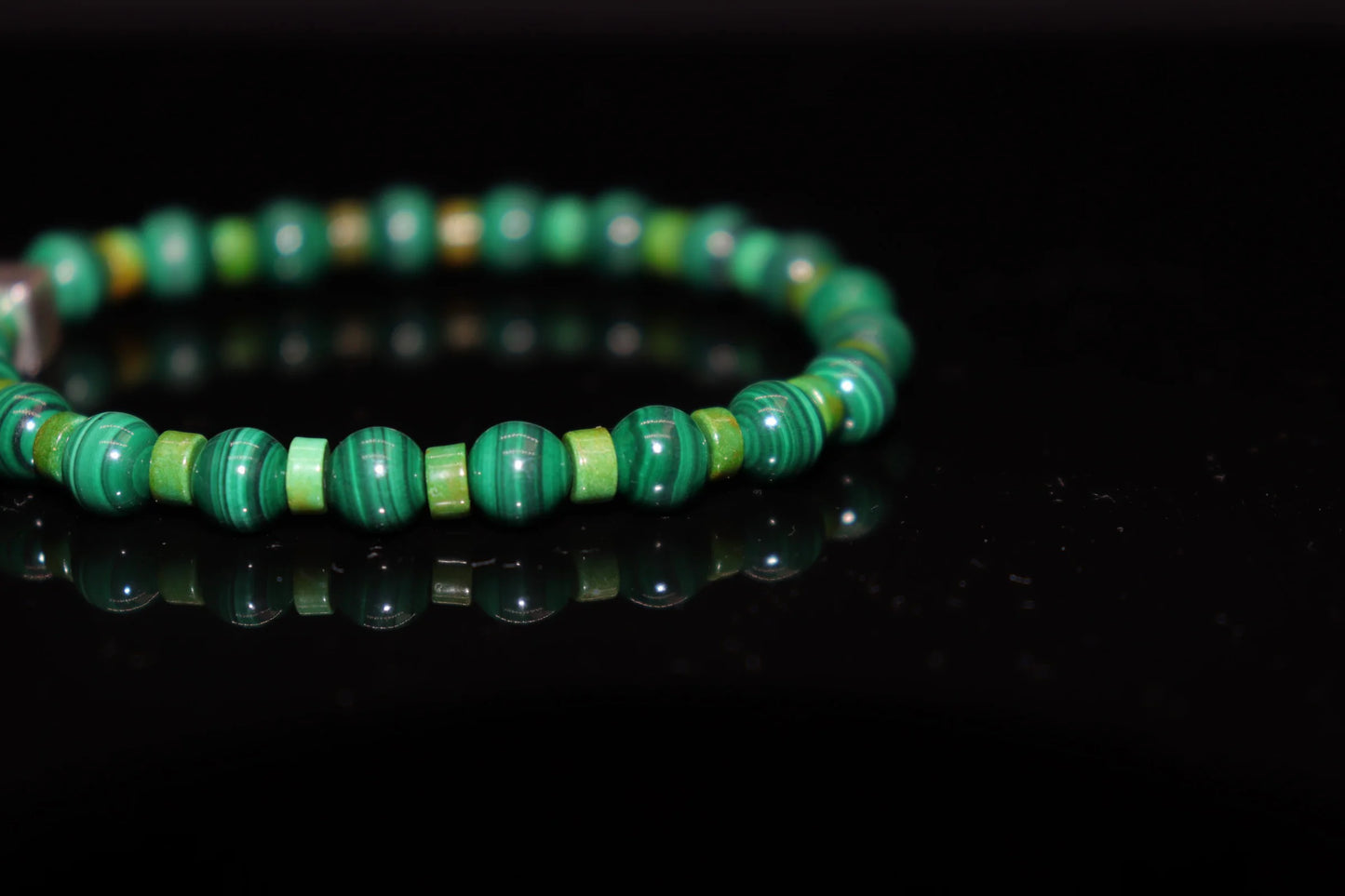
Malachite Silver Bracelet (6mm)
Malachite Silver Bracelet (6mm)
Couldn't load pickup availability
★ Custom - made according to your exact wrist size
★ Free shipping and returns
★ 30 - day satisfaction guarantee
★ Free resizing for new customers
Malachite beads (6 mm), paired with 925 Sterling Silver beads. Comes with a cotton pouch.
Malachite beads glow in deep green with a glassy to silky sheen, the bands of light and dark green seeming to ripple as the beads turn in the light. Inside, layer upon layer of concentric rings curl like the growth rings of a tree – each band one page of the stone's slow, rhythmic growth. The play of light across the green feels deep and stately, like sunlight moving through an ancient forest, majestic yet serene.
Stone Stories
- The "Stone of Transformation": ancient hands drew copper from its green – change made visible, nature's own alchemy
- In Egypt, green was the colour of new life, and the blessed afterlife was called the "Field of Malachite" – a stone of renewal
- In Rome it was the "Peacock Stone", sacred to Juno – carried as a talisman of protection
- Linked with the heart: an emblem of love, renewal and calm courage
- Adored by the Russian court – the Malachite Room of the Winter Palace and the great pillars of St. Isaac's Cathedral were clad in its green
The Gaze of Eternity, the Rings of Time
Hold it up to the light, and the green seems to breathe: ring upon ring, the stone has written its own chronicle, as a tree writes its years, as the sea writes its tides. The ancients read the same quiet wonder. In Egypt, green was the colour of new life – the afterlife itself was called the "Field of Malachite" – and its concentric rings were the eye of the god, watching over the wearer. In Rome it was the Peacock Stone, sacred to Juno, a guardian against lightning and ill fortune. And when the first smiths drew fire from a green stone and found red metal waiting inside, they glimpsed a miracle: change made visible, the plain turned to gold. From the eyelids of Cleopatra to the halls of the Winter Palace, this is a stone that has always promised one thing – that what is heavy may be lifted, and what is worn may bloom again.
Cultural Allusions
- Since around 4000 BC the Egyptians mined malachite in Sinai; the court of Cleopatra painted the lower eyelids with its green paste, and amulets of the "Eye of Horus" were carved from it – green was the colour of rebirth, and the blessed afterlife was called the "Field of Malachite".
- The Romans called it the "Peacock Stone", sacred to the goddess Juno, and wore triangular-cut pieces to ward off the evil eye and lightning; the Greeks offered it to Aphrodite, goddess of love, for its kinship with copper.
- In medieval Germany it was the "Midwife's Stone", trusted to ease childbirth; the knightly epic Parzival numbers it among the gems that could restore the wounded king.
- In the Russian Urals, the folk tales of The Malachite Box tell of the Mistress of the Copper Mountain, a spirit of the mines robed in malachite silk – while the Winter Palace's Malachite Room and the ten great malachite pillars of St. Isaac's Cathedral were clad in Ural stone by the "Russian mosaic" technique.
- Aztec craftsmen carved malachite into images of gods and warriors; in China the same mineral has painted mountains and rivers since antiquity – the green of A Thousand Li of Rivers and Mountains.
Did You Know?
- The name comes from the Greek malachē – "mallow" – for the leaf-green colour; the Chinese name "peacock stone" comes from its feather-like rings.
- Malachite's concentric rings are true growth rings: each band is one layer laid down in a slow rhythm of growth, like the rings of a tree.
- Ancient peoples smelted copper from this green stone – a transformation that looked like alchemy, and gave the stone its modern title, "Stone of Transformation".
- Malachite is soft (Mohs 3.5–4), calling for gentle handling – and it fizzes when it meets acid, even the acid in sweat.
- Today most fine malachite comes from the Copperbelt of the Democratic Republic of Congo; the great Ural mines that clothed the Russian palaces were long ago exhausted.
Care
- Malachite is soft and brittle (Mohs 3.5–4) – protect it from knocks and hard contact, and store it separately in a soft pouch.
- Avoid acid: sweat, perfume, cosmetics and sanitizers can dull its polish – put it on last, take it off first.
- It is porous: keep it dry; if cleaning is needed, wipe quickly with a barely damp soft cloth and dry immediately – never soak, and never use ultrasonic or steam cleaners.
- Keep away from heat and prolonged direct sunlight, which can dull or fade the green.
Wear your story.