VISAXUM
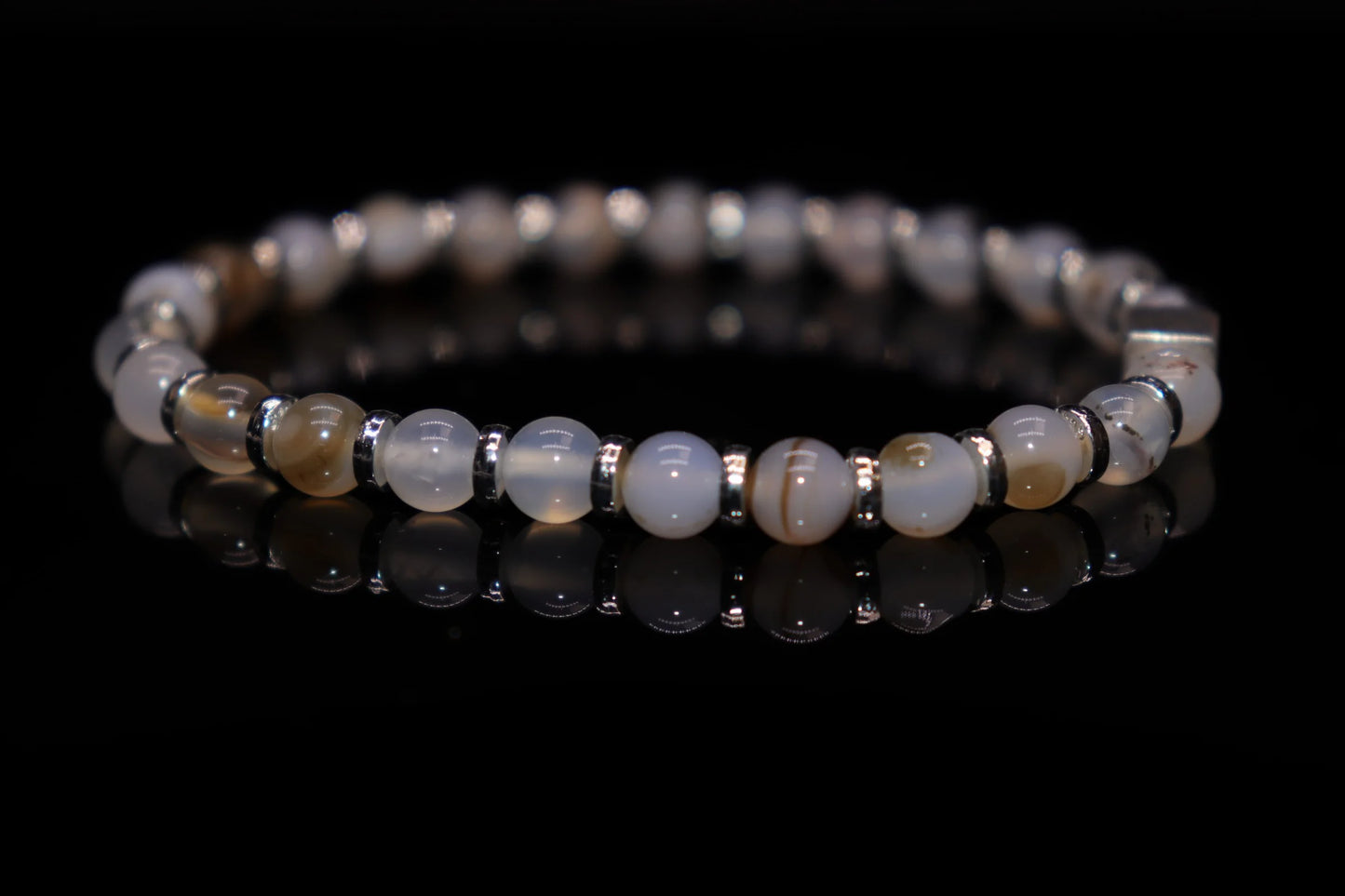
Moss Agate Silver Bracelet (6mm)
Moss Agate Silver Bracelet (6mm)
Couldn't load pickup availability
★ Custom - made according to your exact wrist size
★ Free shipping and returns
★ 30 - day satisfaction guarantee
★ Free resizing for new customers
Moss agate beads (6 mm), paired with 925 Sterling Silver beads. Comes with a cotton pouch.
Moss agate beads show a translucent milky-white to grey-white base with a quiet vitreous-to-waxy lustre; turned in the light, the green moss-like patterns inside seem to float, like a little forest seen through water. The "moss" is not plant but mineral – fine flakes of chlorite and hornblende gathered into mossy, branch-like forms, with black-brown dendrites of iron and manganese oxides suspended deep in the stone. The glow is still and earthy, serene and deep – a fragment of woodland sealed in translucent stone, quiet and full of life.
Stone Stories
- A miniature forest in stone: the green "moss" is not plant but mineral – flecks of chlorite and hornblende sealed in translucent chalcedony
- The "gardener's stone" of old Europe: an 18th-century harvest amulet, hung on branches, ox-horns and ploughs
- Mocha stone: brought to Europe through the Yemeni port of Mocha, beloved of Victorian jewelers and seal engravers
- Called the "stone of abundance": an abundance that must be cultivated, steadily – like the garden pictured within the stone
The Forest in the Stone
Pliny told of a ring stone of King Pyrrhus of Epirus on which Apollo and the nine Muses appeared of themselves – "the work not of art but of nature, so disposed that each Muse bore her own attribute." The ancients called such pictures rising in stone lusus naturae, "nature's games." Moss agate is the quietest round of that game: inside a translucent pebble lies a whole small forest – moss, water-grass, fern shadows – landscapes that minerals grew for themselves across aeons. In the 18th century, English farmers hung it on branches and ox-horns, praying that their crops might flourish as the moss within the stone had done; in the Victorian age it came in through the port of Mocha, and became scenery for seals and jewelry. Wear it, and carry with you a little wood that will never wither – it needs no rain and no sun, for it is the memory of growth that stone learned to keep.
Cultural Allusions
- Pliny the Elder, in Book 37 of his Natural History, recorded the most celebrated of all natural pictures in stone: the agate of King Pyrrhus of Epirus, on which Apollo and the nine Muses appeared "not by art, but by nature's own hand," each Muse bearing her own attribute; he also noted Indian agates that showed "rivers, woods and beasts of burden." These are the earliest famous accounts of the family to which moss agate belongs – gems of chalcedony bearing natural pictures – though Pliny did not describe moss agate itself. In the Middle Ages and the Renaissance such lusus naturae were revered as miracles, and the story of Pyrrhus's agate was copied and recopied.
- In the 18th century, farmers across rural Europe wore moss agate as a harvest charm – hung on branches, ox-horns and ploughs, so that the crops might thrive like the growth pictured within the stone. The great authority on amulets, E. A. Wallis Budge (formerly of the British Museum), recorded in his Amulets and Superstitions (1930): "A farmer will wear an amulet of moss-agate to ensure a plentiful harvest." The modern nickname "gardener's stone" descends from this old tradition.
- Moss agate owes its old name, mocha stone, to the Yemeni Red Sea port of Mocha (today Al Mukha), through which European merchants imported it in the 18th–19th centuries. In the Victorian age it was used for jewelry and seals and kept in homes as a lucky stone; Europe even made "Mocha ware" – pottery glazed to imitate its branching patterns, the earliest dated piece a cup of 1799, with "mocoe beakers" in records from 1792: proof of how well-known its patterns had become.
- In India the tradition is alive, not merely remembered: at Cambay (Khambhat), where moss agate is called suabhaji, one of the four classic Cambay agates, bead-making has continued without a break since the Indus Valley (Harappan) civilisation – the site praised as perhaps the only place where the Harappan agate-bead craft still lives, awarded India's Geographical Indication "Agates of Cambay" in 2008. The V&A in London holds a green moss agate cup and saucer made at Cambay around 1850, turned on the bow-driven lathe of the old craft.
- The taste for landscape stones ran long: Scottish agates, including pieces with scenic or treed patterns, were used in jewelry for centuries and shone in the Victorian era. And in the 2020s moss agate rose again – as the signature gem of unconventional engagement rings: CustomMade says its moss agate sales went from "almost zero in 2020" to the top five of its coloured stones by 2023, and brand Venvs calls it their best-seller of 2023; the global market was estimated at about US$58 million in 2025.
Did You Know?
- Technically it is not an agate at all: true agates show concentric banding, which moss agate lacks – it is "dendritic chalcedony," sold as agate by commercial habit (IGS).
- The "moss" is entirely mineral: green comes from chlorite and hornblende, black-brown from manganese and iron oxides, red from goethite and hematite; as iron oxidises, green can turn brown or red – one stone may hold all three.
- An estimated 20%–60% of agate on the market is dyed: loud, even green usually means dye – natural moss agate has depth, its green floating as three-dimensional inclusions inside the stone.
- Montana moss agate is not green but red, orange and amber with black dendrites – washed down the Yellowstone River from volcanic country in Wyoming; its colour comes from iron oxides (red) and manganese oxides (black).
- It became the 2020s' wedding-ring gem: CustomMade's sales went from "almost zero in 2020" to the top five of its coloured stones by 2023, and the global market was estimated at about US$58 million in 2025.
Care
- Clean with warm water, mild soap and a soft cloth; avoid sudden temperature changes, which can crack cryptocrystalline quartz.
- At 6.5–7 on the Mohs scale it is softer than diamond and corundum – keep it away from harder gems, stored separately in its own pouch or compartment.
- Keep it away from household chemicals and cleaning agents, which can dull the surface.
- The holes of 6mm beads are thin-walled – do not force the cord when restringing; store the silver bead apart from the stones so silver tarnish does not touch them.
Wear your story.