VISAXUM
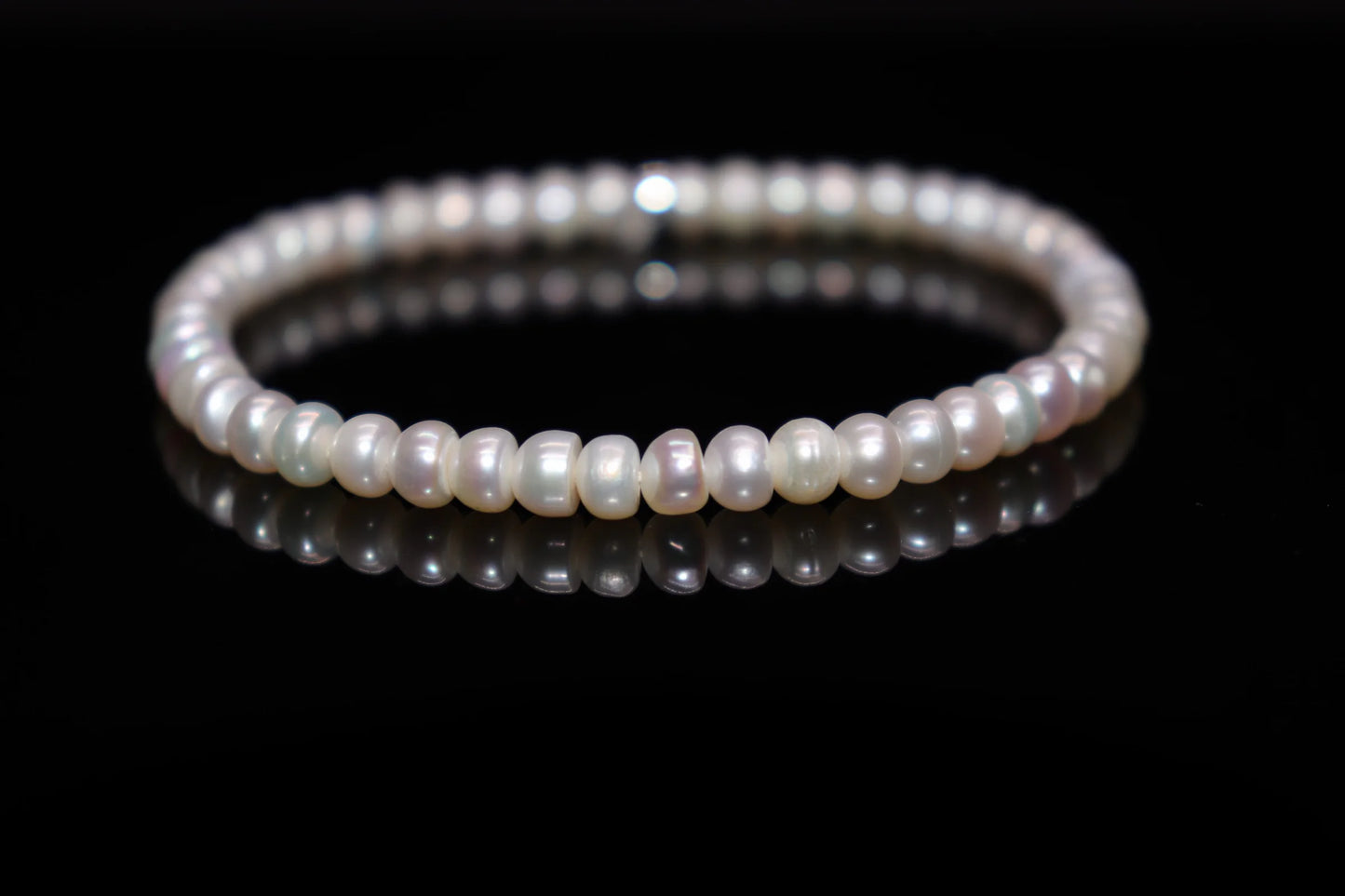
Pearl Silver Bracelet (6mm)
Pearl Silver Bracelet (6mm)
Couldn't load pickup availability
★ Custom - made according to your exact wrist size
★ Free shipping and returns
★ 30 - day satisfaction guarantee
★ Free resizing for new customers
Pearl beads (6 mm), paired with one 925 Sterling Silver logo bead. Comes with a cotton pouch.
- In Rome the pearl was the symbol of Venus – Caesar, claiming descent from the goddess, made it his personal emblem
- In medieval Europe the pearl became the pearl of the Virgin – her very title margarita means "pearl"
- In India it is the gem of the moon: mukta, the stone of Chandra in the nine-jewel Navaratna
- One of the three June birthstones (with moonstone and alexandrite), and the traditional gift for a 30th wedding anniversary
Tears of the Moon
The Indians say the moon wept for his stolen wife, and his tears fell into the sea where the oysters drank them and turned them to pearl. The Arabs say a dewdrop full of moonlight falls into the ocean, and the oyster that swallows it gives back a pearl. The Chinese tell of mermaids who weep pearls onto the shore. Every people that ever dived for it agreed on one thing: a pearl is moonlight that learned to be solid – a small, round piece of the night sky, made by a living creature in the dark of the sea. Pliny set it at the head of all precious things; the Gospel made it the price of heaven itself. Wear it, and carry a drop of the moon's light made solid – no two pearls are ever alike.
Energy Properties
- Called "Tears of the Moon": believed to carry the quiet energy of moonlight and water, linked to the moon's phases
- Believed to calm the nerves and soothe the emotions, helping self-acceptance and the release of anger
- Believed to foster honesty, wisdom and intuition – and called a stone of compassion and love
- In Vedic astrology the gem of the Moon (Chandra) and the birthstone of Cancer: believed to comfort a weak moon in the horoscope
Cultural Allusions
- In Rome pearls stood above diamonds. Pliny opened his chapter on them by declaring that pearls "hold the first place and the highest rank among all precious things": Pompey had his own portrait made of pearls at his triumph, the lady Lollia Paulina went to a dinner engagement glittering with 40 million sesterces' worth, and in 46 BC Caesar restricted by law which classes might wear them. The Romans called a pearl unio – "the unique one" – for no two pearls were ever alike. The thread runs on through Europe's crowns: four great drop pearls of the British Imperial State Crown are believed to have come from Catherine de' Medici's dowry of six ropes of large pearls, given by her uncle Pope Clement VII, passed through Mary, Queen of Scots, and bought by Elizabeth I.
- Cleopatra's famous wager with Mark Antony – a pearl dissolved in vinegar and drunk to win a bet of ten million sesterces – rests on Pliny's account, written a century later, and has been doubted since the nineteenth century: "no such vinegar exists," noted the translator. Yet in 2010 the classicist Prudence Jones showed that 5% acetic acid dissolves a one-gram pearl in 24 to 36 hours – the feat is chemically possible, though Pliny's timing was compressed (a legend, told as legend).
- The Persian Gulf was the ancient centre of natural pearls: Bahrain's pearling tradition reaches back more than 4,000 years, to Assyrian records of 2000 BC and the Dilmun civilisation. Pliny reported that the pearls of the Gulf were "held in special esteem". In 1877 pearls were still three-quarters of Bahrain's exports; then Japanese cultured pearls and the oil of 1932 ended the old world – by 1950 the trade was gone. Its memory survives as a UNESCO World Heritage site: "Pearling, Testimony of an Island Economy".
- In 1893 Mikimoto Kōkichi – the "Pearl King" – produced the world's first cultured pearl, and by 1916 the decisive patent was in hand: the method of implanting a bead wrapped in living mantle tissue that still grows pearls today. He won the lawsuit that established cultured pearls as true pearls in 1920s Paris, and in 1927 Edison called his achievement "one of the wonders of the world". His dream was "to adorn the necks of all women throughout the world with pearls".
- In China, the fourth-century Sou Shen Ji tells of the jiaoren – mermaids of the southern sea whose tears become pearls, remembered in Du Fu's verse "a guest from the southern sea gave me a pearl of the mermaid"; the Han-era Huainanzi tells of the Marquis of Sui, who saved a wounded serpent and received in return a great pearl glowing "like moonlight", ranked with the famous jade of He Shi. The Qing emperors made the freshwater pearls of their ancestral rivers – dongzhu – the highest jewel of the court, worn in the imperial crown and, by law, in the court necklace of the emperor alone.
Did You Know?
- A pearl is about 90% calcium carbonate – aragonite, the mineral of chalk and marble – yet at Mohs hardness 2.5–4.5 it is among the most delicate of gems, calling for gentle care.
- The "grain of sand" story is a myth: a pearl forms when a foreign body enters the oyster's mantle tissue and epithelial cells wrap it, layer by layer, in nacre – a living tissue reaction, not an irritation.
- X-rays tell natural from cultured pearls: natural pearls show onion-like growth rings, cultured pearls reveal the bead nucleus inside.
- In the Buddhist sutras the wish-fulfilling "mani" pearl of the wheel-turning king – "naturally streaming pure light, illuminating all four directions" – is one of the seven treasures; the lists vary from sutra to sutra, and the pearl appears in the Lotus Sutra's version.
- In Botticelli's "Birth of Venus" the goddess rises from the sea on a great scallop shell – read by art history as a pearl rising from its oyster, though the Greek original only says she was born from foam.
Care
- Keep pearls away from acid: perfume, sweat, vinegar and lemon juice etch the surface; chlorine and bleach fog it forever – put your pearls on last, take them off first.
- Wipe with a very soft dry cloth after wearing; for deeper cleaning use only warm soapy water – never ultrasonic or steam cleaners.
- Keep them from heat, strong light and dry air, which dehydrate and crack the nacre; store them flat in a soft pouch, never hanging by the thread.
- Pearls are soft – keep them away from hard gems and metal; have the bracelet restrung every year or two, as the thread weakens with wear.