VISAXUM
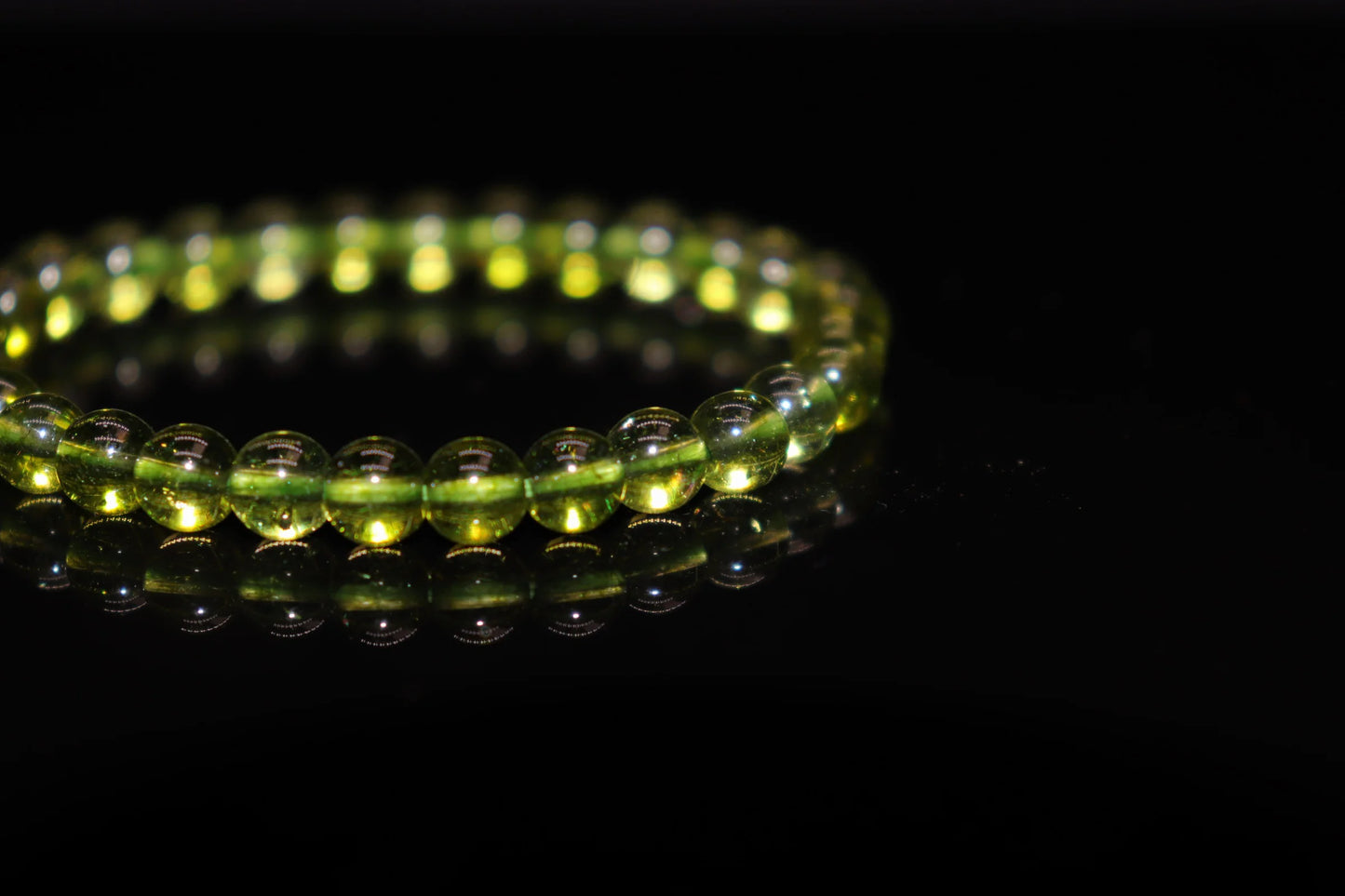
Peridot Silver Bracelet (6mm)
Peridot Silver Bracelet (6mm)
Couldn't load pickup availability
★ Custom - made according to your exact wrist size
★ Free shipping and returns
★ 30 - day satisfaction guarantee
★ Free resizing for new customers
Peridot beads (6 mm), paired with 925 Sterling Silver beads. Comes with a cotton pouch.
Natural peridot shows a clear, bright yellow-green to olive-green colour – the iron in its own crystal structure – with a vitreous to slightly greasy lustre that plays over the beads as they turn. Inside, tiny disc-shaped "lily-pad" inclusions around chromite crystals, and the doubled facet edges visible under a loupe, are natural marks left by the stone's growth. Its light is like morning sun through new leaves – clear, warm and quietly radiant.
Stone Stories
- The "gem of the sun": ancient Egypt's amulet against the terrors of the night – still the national gem of Egypt today
- The "evening emerald": the Romans prized peridot for a green that stays bright in candlelight and moonlight
- Cologne Cathedral's Shrine of the Three Kings long displayed a 200-carat stone called "emerald" – it is peridot
- Called the "Stone of Compassion" and the "Stone of Abundance"; linked with the solar plexus and the heart, a bridge between will and compassion
- August's birthstone since the official list of 1912, and the traditional 16th wedding anniversary stone
A Sunset, Held in Green
This green is sunlight that chose to stay. It was born in the fiery mantle of the Earth and carried upward on the breath of volcanoes; the Egyptians, seeing the sun itself in it, wore it against the terrors of the night, and made it the stone of their land. The Romans, watching it keep its light in the dark, called it the evening emerald. For centuries a great green stone sat in a shrine in Cologne, mistaken for an emerald, waiting quietly to be known for what it is – the green of August, the colour of the olive branch, of all things that ripen slowly and keep their light. Wear it, and carry a small piece of the sun that never sets.
Cultural Allusions
- The island of Topazos: Pliny wrote of a Red Sea island wrapped in fog, so hard to find that its very name meant "to seek"; the first stone was presented to Queen Berenice II, and a four-cubit statue of it was carved for Queen Arsinoë. The 1911 Encyclopaedia Britannica judged plainly: the ancients' "topaz" is our peridot.
- The secret island: Egypt's royal monopoly on St. John's Island (Zabargad) supplied the world for centuries; the source was lost, and rediscovered only around 1905 – yet gemologist Eduard Gübelin still ranked its crystals among the finest peridot on Earth.
- Some historians believe Cleopatra's famous "emeralds" were peridot from Egypt's own mines; Strabo recorded that the island was once called Ophiodes, "Serpent Isle", until a determined pharaoh drove the snakes into the sea.
- In the Middle Ages, peridot is believed to have come to Europe with the crusaders for church treasuries; in the eleventh century Bishop Marbode wrote in his Book of Gems that set in gold – the metal of the sun – it dispelled the fears of the night, and it earned the name "Devil Chaser".
- The otherworldly stone: peridot some 4.5 billion years old has been found inside iron meteorites, in lunar soil, in Martian samples and in comet dust collected by NASA's Stardust – GIA calls it older than any gem on Earth, including diamond.
Did You Know?
- Peridot is one of only two "extreme gems" named by GIA: it crystallises deep in Earth's mantle and rides to the surface on volcanic eruptions.
- The Greeks and Romans called this stone "topaz"; the name peridot only became common in Europe in the 18th century (perhaps from French peritot, or from Arabic faridat, "a gem").
- Hawaii's Papakōlea beach is green because waves concentrate heavy peridot crystals – nicknamed "Hawaiian diamonds"; it is one of only four green sand beaches on Earth, and taking the sand is illegal, with fines up to US$100,000.
- Under a loupe, the facet edges of peridot appear doubled – a signature of its strong double refraction; the disc-shaped "lily-pad" inclusions around chromite crystals are its fingerprint.
- The world's largest faceted peridot, 311.8 carats from Egypt's Zabargad Island, rests in the Smithsonian; Paloma Picasso's 1982 pendant for Tiffany & Co. mounted a 284-carat stone.
Care
- Mohs hardness 6.5–7 – softer than many gems; store separately from harder stones and avoid rubbing against everyday grit, which can scratch it.
- Clean only with warm soapy water and a soft brush; never use ultrasonic or steam cleaners.
- Sensitive to sudden temperature changes, which can crack it; keep it away from acids, bleach and chlorine, and remove it for swimming.
- Store it alone in a soft pouch; for bead bracelets, have the string checked regularly.
Wear your story.