VISAXUM
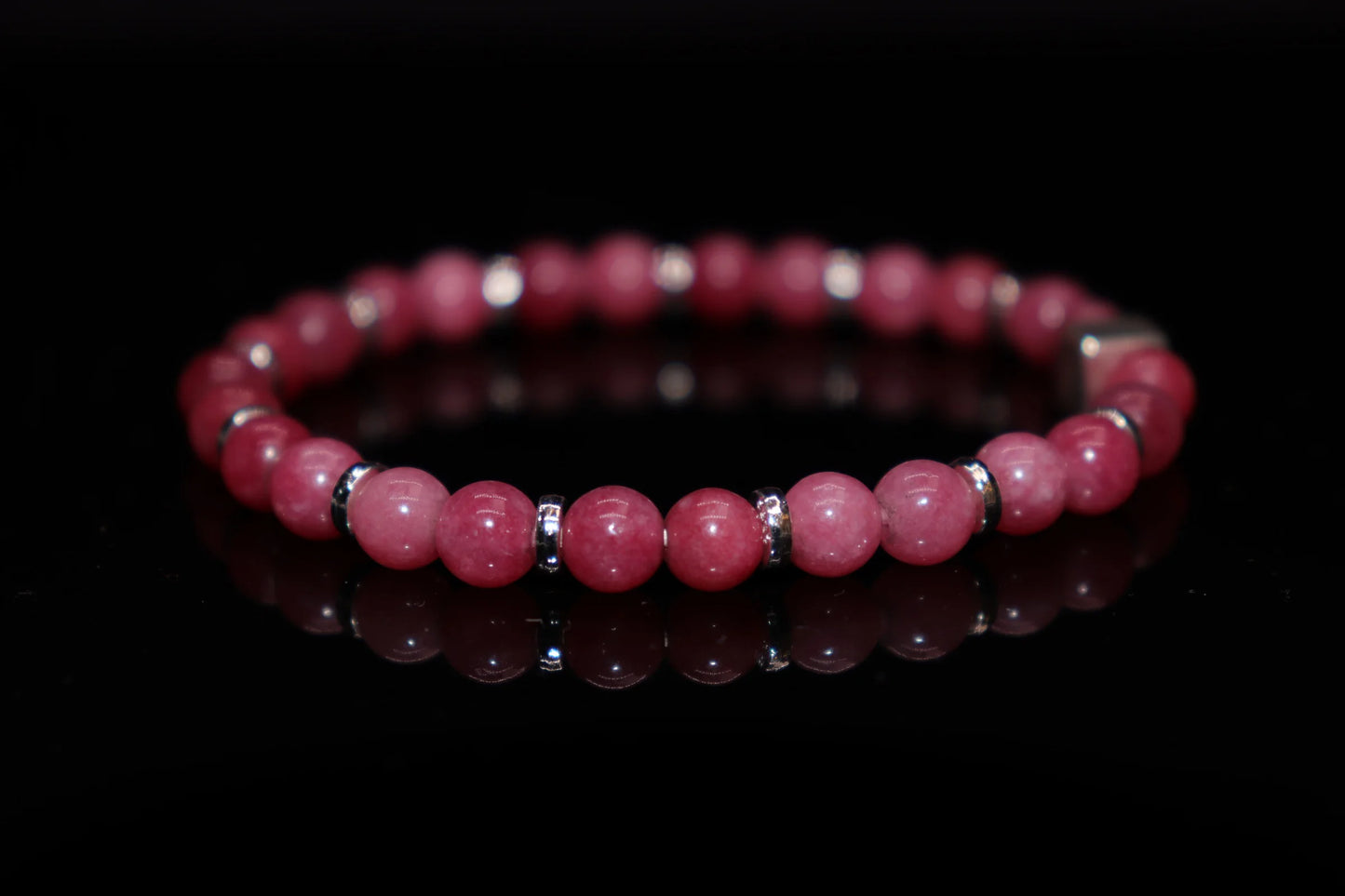
Rhodochrosite Silver Bracelet (6mm)
Rhodochrosite Silver Bracelet (6mm)
Couldn't load pickup availability
★ Custom - made according to your exact wrist size
★ Free shipping and returns
★ 30 - day satisfaction guarantee
★ Free resizing for new customers
Rhodochrosite beads (6 mm), paired with 925 Sterling Silver beads. Comes with a cotton pouch.
Natural rhodochrosite glows rose-red to pink with a vitreous to pearly sheen; as the beads turn, the concentric pink-and-white bands shift gently like the rings of a rose pressed into stone. Fine growth lines and layered banding run through the beads, laid down ring by ring by mineral-rich hot waters – the stone's own record of how it grew. The sheen is warm and mellow, holding the colour of the high Andes in ring after ring of quiet, tender memory.
Stone Stories
- Named for the rose: rhodochrosite comes from the Greek rhodón and khrōsis – "rose-coloured", so named in 1813
- The Incas' sacred stone: legend says the blood of great kings and queens, buried in the mountains, turned to stone – the "Inca Rose"
- The Diaguita legend of forbidden love, forgiven by the king – the stone became the emblem of peace, forgiveness and eternal love
- In Andean tradition, an emblem of peace, forgiveness, eternal love and faithfulness
- A nation's unofficial gem: Argentina's "national stone" by common regard, though no law ever made it so – and the official state mineral of Colorado since 2002
The Rose of the Andes
The Incas said that when a great king or queen was laid to rest in the mountain, their blood turned to stone – and the mountain kept, for those who came after, a rose. Rhodochrosite takes its name from the Greek for "rose-coloured," but the rose it holds is older than any name: in the high Andes of Argentina the stone is still called Inca Rose, banded in concentric rings of pink and white, like a rose pressed into stone, like a heart with its rings of memory. In 1986 miners blasted open a series of connected caverns at Capillitas, hung with stalactites of rhodochrosite up to one and a half metres long – a cave full of roses. Wear it, and carry a rose that never wilts: the colour of the high mountain, warm at the wrist, ring within ring of the earth's slow, tender memory.
Cultural Allusions
- The name came in 1813: the German mineralogist Johann Friedrich Ludwig Hausmann named the mineral Rhodochrosit from the Greek rhodón ("rose") and khrōsis ("colouring"), for its rose-red colour – the type specimen came from a Romanian silver mine, now identified as Săcărâmb. The rose-red itself is the work of manganese: Mn²⁺ in the crystal lattice; calcium replacing some of the manganese softens it to palest pink.
- The Incas held it sacred: the old belief ran that the blood of great rulers, entombed in the Andes, congealed into stone. Archaeology confirms the mountain knew them – Indians were panning the gold of Capillitas since the 13th century; in 1934 the German geologist Franz Mansfeld "rediscovered" the deposit and found Inca burial ornaments there, then mined some 10,000 pounds of rough rhodochrosite.
- In Andalgalá they still tell the legend of the Diaguita: near Lake Titicaca stood a temple of the chosen maidens (Ajllas); a warrior, Tupac Canqui, entered the forbidden place by chance and fell in love with the maiden Ñusta Ajlla. The two fled south and settled where Andalgalá stands today. When she died and was buried on the mountain top, a messenger found her tomb stone "blooming" with rose-petal carvings, and brought it to the Inca king – who, moved, forgave the lovers and made the rose stone the ornament of princesses, a token of peace, forgiveness and eternal love. (The tale as told in Argentine congressional records – legend, not chronicle.) The name "Inca Rose" itself is younger: Buenos Aires jewelers coined it in the 1930s after miners opened a cavern hung with rhodochrosite stalactites, and by 1939 London already used it.
- In Colorado, the mine called Sweet Home dug silver from the 1870s on, and rhodochrosite was long dismissed as waste – miners even carried it home in their lunch boxes. Then in August 1992 the team of Bryan Lees freed "Alma King": a football-sized, ruby-red, perfect rhombohedron. The moment of its discovery was filmed by chance – a Denver museum crew was shooting a documentary in the mine that very day; the Coors Foundation bought the crystal and gave it to the Denver Museum of Nature & Science, where it stands today. That discovery helped push Colorado to name rhodochrosite its state mineral in 2002 – proposed, delightfully, by high-school students in Bailey.
- In 1986 miners at Capillitas blasted into a chain of connected caverns, the largest 15 metres wide and 6 metres high, hung with rhodochrosite stalactites and stalagmites up to 1.5 metres long; some 20 tonnes of material went to Buenos Aires, and polished "bull's-eye" slices – 20 to 22 rings of concentric banding – became collector legends, a 16-inch slice once selling for US$60,000. On the other side of the world, a cavern at Wuzhou, Guangxi, China, yielded in 2009 the "Empress of China": intergrown crystals rising like a blooming red rose, shown at Tucson in 2011, at Beijing's National Museum of China in 2025, valued at over 20 million RMB.
Did You Know?
- It is one of the softest gemstones: at Mohs 3.5–4, a knife blade can scratch it – and it is easily confused with rhodonite, which looks alike but is far harder; the sure test: rhodochrosite fizzes in dilute acid, rhodonite does not.
- Its pink-and-white rings are the rings of a stalactite: mineral-rich hot waters laid them down, layer by layer, in cave systems – the pale bands rich in calcium oxide, the deep red bands nearly pure manganese oxide.
- Argentina's "national stone" has never been made so by law – bills in Congress from 2014 to 2025 all failed; the only legal status it ever won is as Colorado's state mineral (2002), proposed by high-school students.
- In Chinese it is called hongwenshi (红纹石), "red-pattern stone," a market favourite for bracelets and pendants; the 2009 "Empress of China" from Guangxi overturned the old view that Chinese rhodochrosite could not match the best of Peru.
- The Kalahari field of South Africa produced its masterpieces in the late 1970s and early 1980s – "red gold" from N'Chwaning and Wessels; a collection of 27 pieces sold at Bonhams in 2014 was estimated at US$200,000–250,000.
Care
- Above all, keep it from acid: the stone is manganese carbonate, and vinegar, lemon juice and acidic cleaners make it fizz and corrode – keep it far from them.
- Take it off for baths, swimming, washing-up and housework; ultrasonic, steam, mechanical cleaning and jewelry cleaning solutions are all forbidden, as is bleach.
- At Mohs 3.5–4 it is one of the softer gems – wear it apart from other jewelry, and consider spacers between the beads.
- Heat and strong light are enemies too: a torch flame darkens and cracks it, and long direct sun fades it – store it in the dark and dry; clean gently with a soft brush, mild soap and warm water, and use a silver cloth for the bead.
Wear your story.