VISAXUM
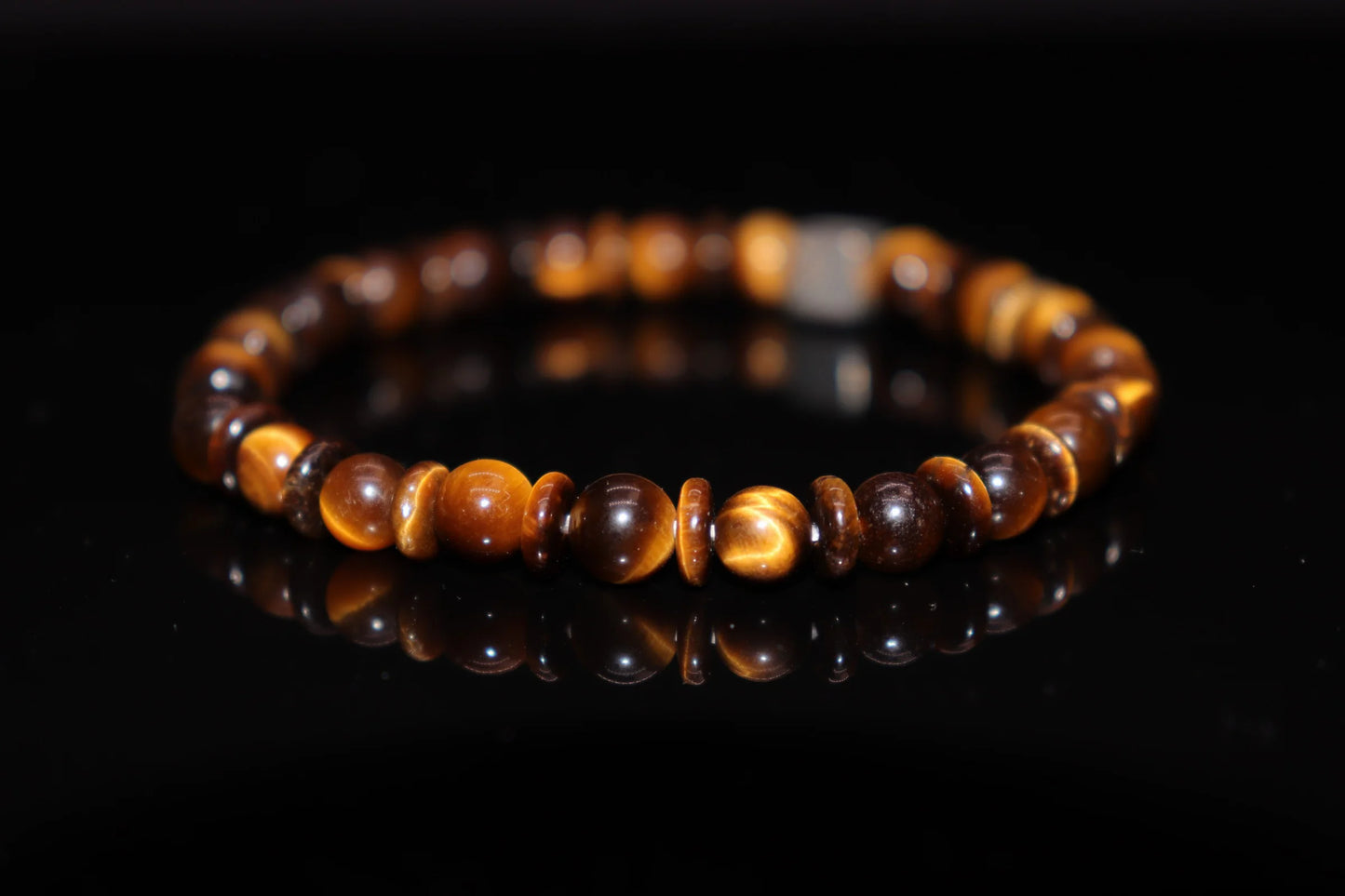
tiger's eye Silver Bracelet (6mm)
tiger's eye Silver Bracelet (6mm)
Couldn't load pickup availability
★ Custom - made according to your exact wrist size
★ Free shipping and returns
★ 30 - day satisfaction guarantee
★ Free resizing for new customers
Tiger's eye beads (6 mm), paired with one 925 Sterling Silver logo bead. Comes with a cotton pouch.
- A family of eyes: tiger's eye is quartz replacing blue asbestos fibres, tinted gold by oxidised iron — its kin are the blue hawk's eye and the red-brown bull's eye, one stone in three colours
- Born on the Orange River: picked up there in 1784 by the French naturalist François Levaillant and first described scientifically in 1811 — Europe had never seen the stone before
- Once priced like gold: in the 1870s, London sold it at about 25 shillings a carat, close to the price of gold, before rich South African finds crashed the price
- The tiger of Chinese tradition: "the tiger is the yang creature, lord of the hundred beasts, able to seize and blunt sharpness and devour ghosts and spirits" — painted on doors, it kept ghosts away
The Unblinking Gaze
In 1784, on the banks of South Africa's Orange River, a French naturalist bent down and picked up a pebble that seemed to look back at him — golden-brown, with a band of light that slid across its surface like an eyelid opening. It was, in truth, a buried eye of blue asbestos fibres, transmuted over the ages by iron rusting to gold, each parallel thread woven into the gleam we now call a tiger's gaze. For a few years in the 1870s, London priced this pebble's worth close to gold itself. And long before Europe knew its name, China already knew the tiger — "lord of the hundred beasts," wrote the Han scholar Ying Shao, able to "seize and blunt sharpness, and devour ghosts and spirits," and so it was painted on doors to guard the home. To wear the tiger's eye is to keep that gaze at your wrist: the look that never blinks, that sees clearly and does not flinch. Let the tiger keep watch.
Energy Properties
- Called the "courage stone": believed to steady willpower and confidence, helping one face fear, hesitation and self-doubt
- Worn as a protective stone: believed to keep off negative energy, curses and the evil eye — a trusted companion for travellers
- The "wealth stone" of Chinese custom: believed to draw benefactors, fortune and career chances, earning it the nickname "entrepreneur's stone"
- Believed to calm and clarify: to steady the mind, calm mood swings and part thought from emotion, and to balance yang and yin; linked to the solar plexus, the seat of the will
Cultural Allusions
- In 1784 the French naturalist François Levaillant picked up tiger's eye pebbles along the Orange River in South Africa, describing "a curious stone... changing its hue like an opal or cat's eye, but browner in tone, with golden bands"; specimens later reached Berlin's natural history museum, and the chemist Klaproth published the first scientific description in 1811.
- Its first names were awkward: long known as griqualandite, for the Griqualand West fields, and pseudocrocidolite — "false crocidolite" — the English name "tiger's-eye" is first recorded only in 1886; the French call it œil-de-tigre.
- The gold-price moment: in the 1870s a carat of tiger's eye fetched about 25 shillings in London, close to the value of gold; the rich finds of the 1880s put an end to its scarcity, and the stone passed from royal curiosity to worldwide admiration.
- The Roman soldier story is a modern tale: crystal-culture lore has Roman legionaries setting tiger's eye in their shields and sword hilts for courage and protection, but no reliable record supports it — the stone only reached Europe in 1784, and the ancient "eye of Belus" that scholars match to Pliny's list of gems is the cat's eye of chrysoberyl, not tiger's eye.
- The Victorian crush: in the 1880s–90s America was wild for tiger's eye cameos and intaglios, carved in the German town of Idar-Oberstein — survivors include an 1880s 10K gold ring carved with two helmeted Roman soldiers in profile and a scarab-style beetle brooch in red-brown tiger's eye; in 1893 De Beers itself was founded on the same blue-asbestos fields.
Did You Know?
- No synthetic tiger's eye exists: "lab-made" pieces are fibre-optic glass or resin — glass fakes show bubbles and stiff parallel fibres under a loupe, and their band of light is flat and lifeless, while a real band slides deep and smooth as the stone turns.
- Most red "bull's eye" is cooked: golden tiger's eye is heat-treated at 300–450 °C to deepen its red; by a 2024 trade estimate about 63% of market tiger's eye has been heat-treated, and a few red stones are dyed.
- China's only tiger's eye mine is in Xichuan, Henan: discovered in the 1950s–60s while prospecting for blue asbestos, worked in the 1970s–80s and closed since 2011 — today's stock mostly comes from old reserves.
- Its raw material is blue asbestos: the fibres are crocidolite, sealed safely inside quartz in the finished stone, but the dust of cutting and grinding must never be breathed — a hazard that earned it the old name "pseudocrocidolite".
- A 2003 paper in Geology rewrote its origin: Penn State scientists proposed a crack-seal mechanism — some 20 to 100 cycles of cracking and resealing per centimetre of stone — and argued that the moving band of light comes from the asbestos fibres themselves, not from quartz.
Care
- Hard but brittle: hardness 6.5–7 with modest toughness — avoid hard knocks, and take it off before sports and housework.
- No ultrasonic or steam cleaning: heat and vibration can widen cracks, or crack the stone.
- Keep it away from chemicals — perfume, hairspray, detergents, cosmetics — and from long sun and high heat, which can fade its colour.
- Clean by hand with warm water, mild soap and a soft cloth or brush; rinse, dry, and store it apart from harder gems; check the bracelet cord from time to time.