VISAXUM
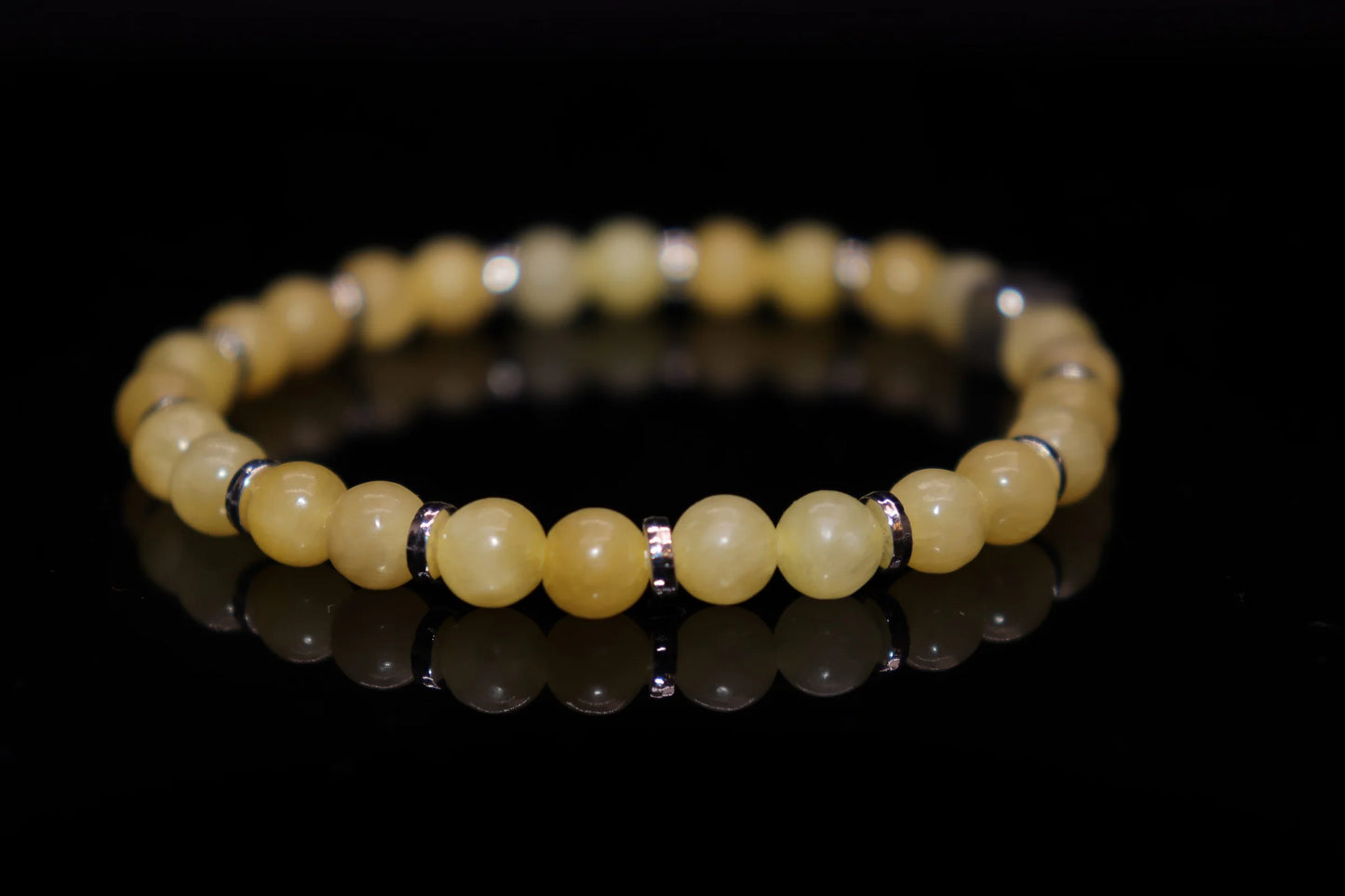
Topaz Silver Bracelet (6mm)
Topaz Silver Bracelet (6mm)
Couldn't load pickup availability
★ Custom - made according to your exact wrist size
★ Free shipping and returns
★ 30 - day satisfaction guarantee
★ Free resizing for new customers
Topaz beads (6 mm), paired with 925 Sterling Silver beads. Comes with a cotton pouch.
Natural topaz shows a clear golden base, and as the bead turns, its vitreous luster flashes bright in the light. Its yellow comes from color centers within the crystal lattice rather than impurities, so it rarely shows the color banding of sapphire — a clear interior carrying only the quiet traces of natural growth. The luster is warm and bright, like sunlight melted into gold, clear and radiant, with a sunny quality all its own.
Stone Stories
- A name with two legends: Pliny traced "topaz" to a mist-wrapped Red Sea island whose name meant "to seek"; others trace it to the Sanskrit tapas, "fire"
- Hardness 8, by definition: the mineral that defines "8" on the Mohs scale – the hardest silicate there is
- The emperors' colour: imperial topaz, the warm orange-pink of Brazil's Ouro Preto, was named for the tsars and once reserved for the imperial family alone
- November's gem of friendship: topaz shares the November birthstone with citrine – "firm friendship is November's, and she bears true love beneath the topaz that she wears"
Named for Fire
Pliny told of a mist-wrapped island in the Red Sea, so hard to find that its stone took its name from the local word topazin — "to seek." Others trace the name to the Sanskrit tapas, "fire," for the golden blaze within the stone. Either way, the ancients were seeking something golden and rare — even if, by a twist of history, the stone they found on that island is the one we now call peridot, while topaz itself walked under another name. The confusion ran as deep as royalty: in the 1740s, a kidney-shaped amber-brown stone of some 1,680 carats from Brazil was offered to a king as possibly the largest diamond in the world — the Braganza "Diamond," its true identity still a mystery; many have suspected it was white topaz. And in the nineteenth century, pink-orange topaz from the Urals was named for the tsars and reserved for the imperial family alone. A stone mistaken for a diamond; a diamond that may have been topaz — wear it, and wear a secret fit for kings.
Cultural Allusions
- The island that never yielded topaz: Pliny's topazos island in the Red Sea — today's Zabargad — was famous for its gems, yet it actually produced peridot; scholars agree that the ancients' "topaz" was peridot, while their chrysolithus was our topaz. The island was so hard to find that in the local tongue topazin meant "to seek."
- The Braganza "Diamond": around 1741, a kidney-shaped amber-brown stone of about 1,680 carats from Minas Gerais was offered to King João V of Portugal as possibly the largest diamond in the world; it has since been called a white sapphire, a white topaz, an aquamarine — and a dark yellow diamond — and it never appears in the official royal inventory. Its identity and its fate remain one of gem history's great unsolved mysteries.
- The tsars' monopoly: in the nineteenth century, pink-orange topaz from the Ural mountains was named imperial topaz for the tsars, and for a time only the imperial family was permitted to own or wear it.
- Pliny's boiling-water test: Pliny records Persian magi testing true gems by dropping them into boiling water — a genuine stone was believed to cool it; later folklore attached the tale to topaz, claiming the hand could enter the pot unharmed, a misattribution that even the 16th-century scholar Cardano mocked as over-credulous.
- Giants in the museums: the world's largest faceted topaz — El-Dorado, 31,000 carats — rests in the Spanish royal collection, and the American Golden Topaz (22,892.5 carats, 172 facets) shines in the Smithsonian — the ancients never guessed how large their golden stone would one day grow.
Did You Know?
- It crackles: rubbed against cloth, topaz becomes strongly charged with static electricity — a property noted in the earliest mineralogy, and a quiet marvel at the wrist.
- Almost every blue topaz in the world is made, not born: the rich sky blues of the trade are the triumph of twentieth-century gem science — irradiation and careful heat turning colourless stone into the vocabulary of Sky, Swiss and London Blue; natural blue topaz, as from Texas, is so rare it is a collector's prize.
- A tough stone with one secret: on the Mohs scale topaz defines hardness 8, yet its perfect cleavage means a sharp knock can split it along the crystal plane — the one weakness of a very strong gem.
- Two "yellow jades" under one name: in China, 黄玉 once meant the yellow nephrite of the jade tradition — "yellow like steamed millet," praised since the Han dynasty; since the 1996 national standard, 黄玉 is the mineral name of topaz, with 托帕石 as the official gem name, ending centuries of confusion.
- A seat in the Navaratna: in Indian tradition topaz is pusparaga — "petal-coloured" — and holds the Jupiter seat among the nine gems of the royal Navaratna talisman, an assignment recorded since the fifteenth-century text Jataka Parijata.
Care
- A strong stone with one weakness: hardness 8, yet perfect cleavage means a sharp knock can split it along the crystal plane — take it off before sport, housework and hard contact.
- Gentle with heat: avoid sudden temperature changes and long direct sun, for some natural golden tones fade with prolonged exposure.
- Clean with warm water, neutral soap and a soft brush — never steam or ultrasonic cleaners; dry it and store it apart from harder gems such as diamond and corundum.
- Watch the cord: faceted beads wear hardest at the string — check it from time to time, and polish the silver bead with a silver cloth, keeping it clear of the topaz.
Wear your story.